Role
Design Lead
Scope
Platform UX · B2B2C
Duration
6-8 months
Summary
SumUp's hospitality products launched as separate MVPs: the kiosk, merchant portal, and kitchen display system(KDS). Merchants waited 3 to 4 weeks for Ops-led installation, had no branding or localisation options, and operated across a fragmented ecosystem. This blocked £2 to £3M in annual revenue from UK, EU, US, and Brazil expansion.
As Design Lead, I owned the end-to-end redesign across all 3 products and proposed the B2B2C design system direction to the SVP of Design.
Outcome: Onboarding reduced from 4 weeks to 5 days. Consumer ordering time dropped from 4.2 to 2.2 minutes. 190k+ monthly orders, 1M+ transactions, 100%+ QoQ kiosk sales growth, £200K annual ops cost avoided.
Problems
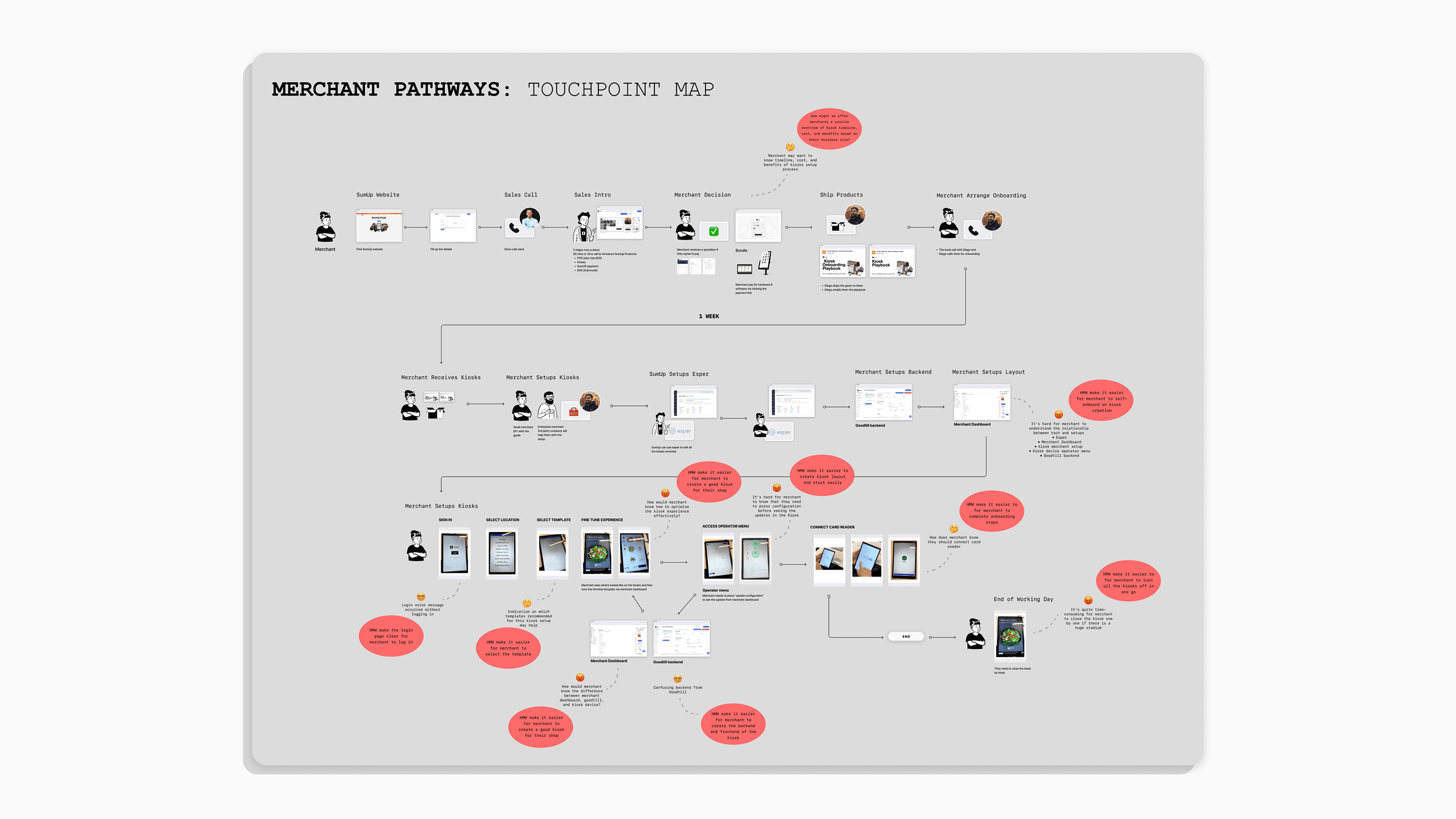
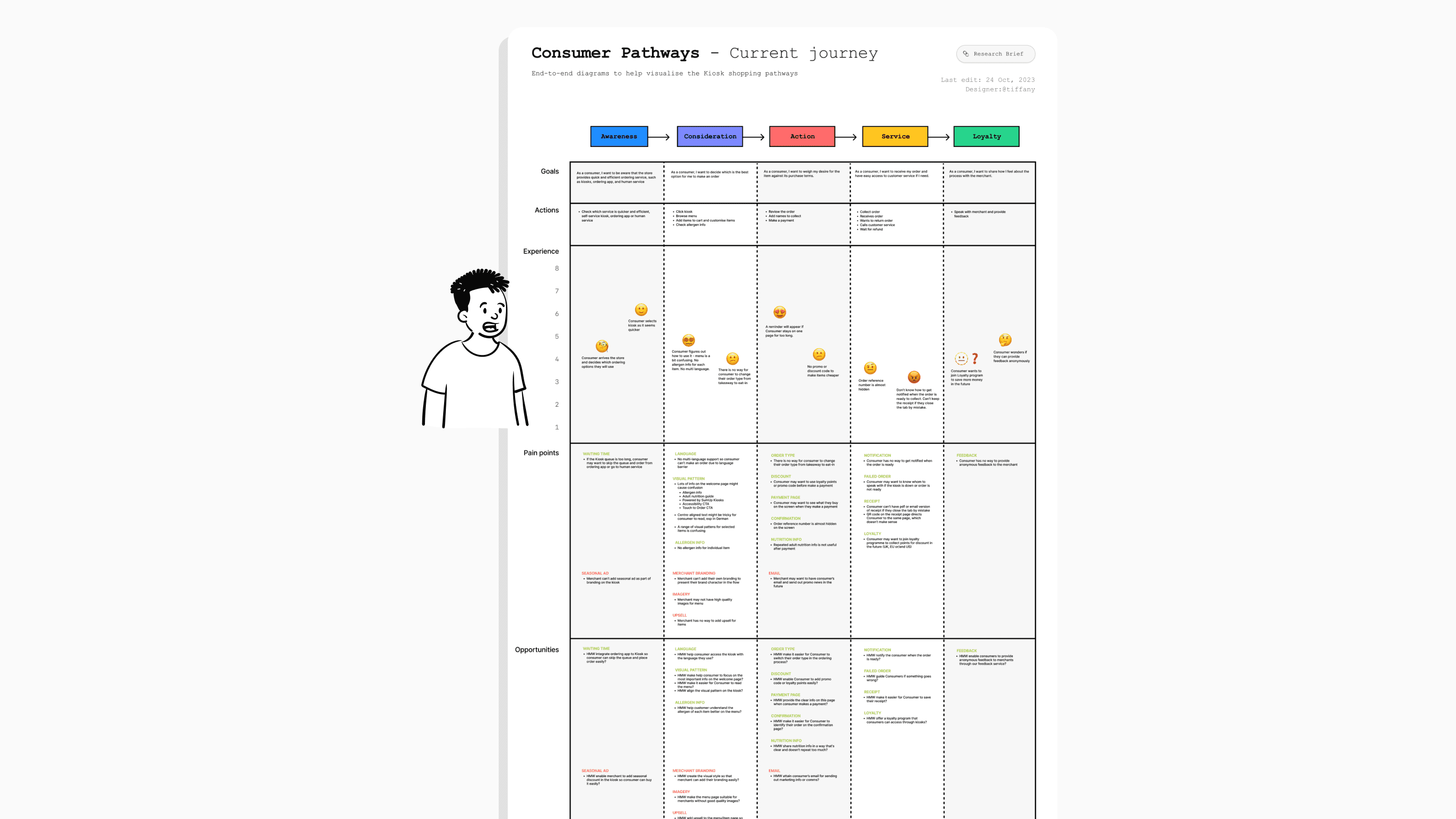
Merchants couldn't onboard without help No setup sequence in the portal meant merchants relied on SumUp's Ops managers for phone calls and on-site visits. 3 to 4 week waits at £600 to £1,200 ops cost each. This blocked scale and created churn risk in the UK.
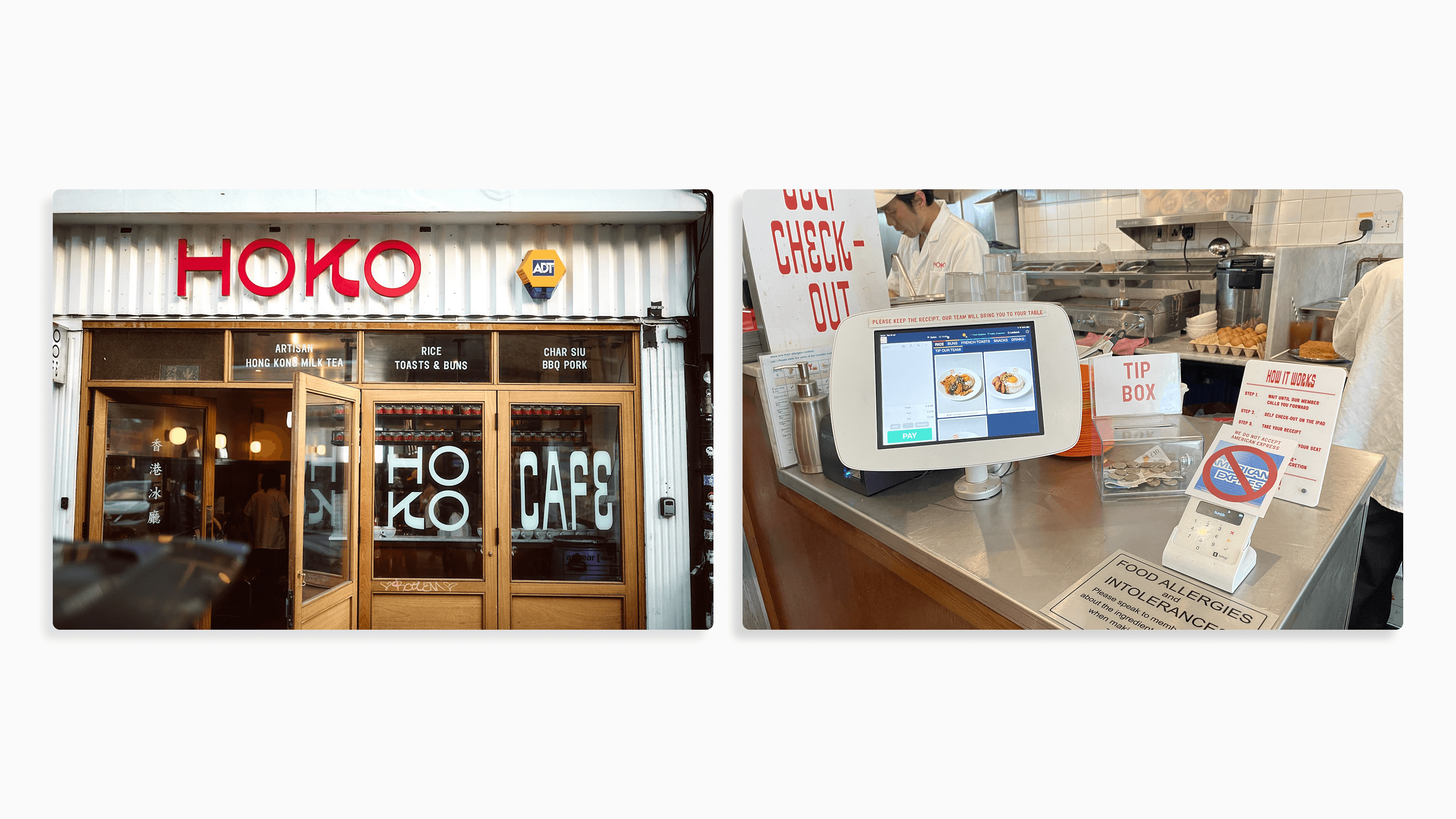
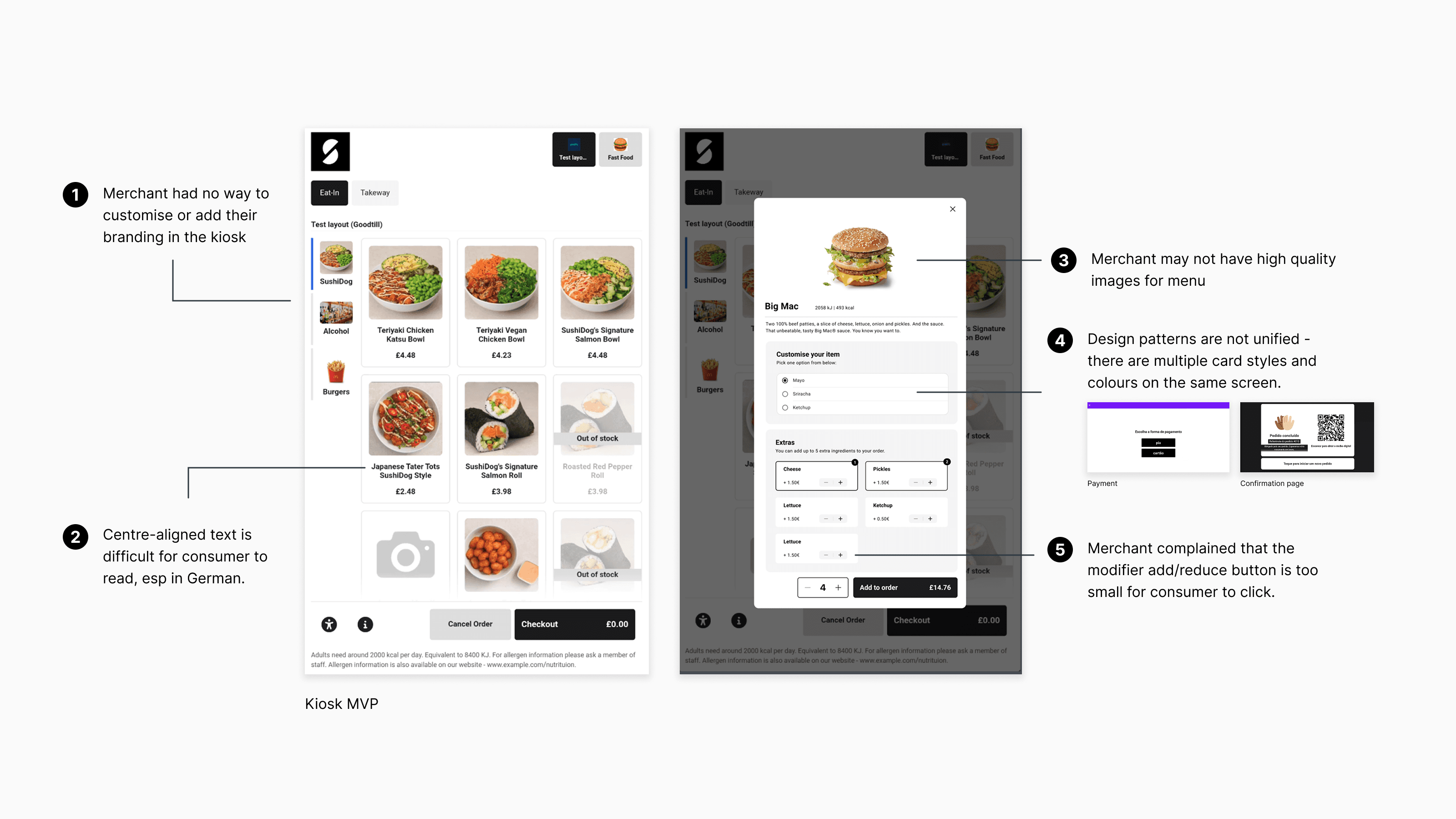
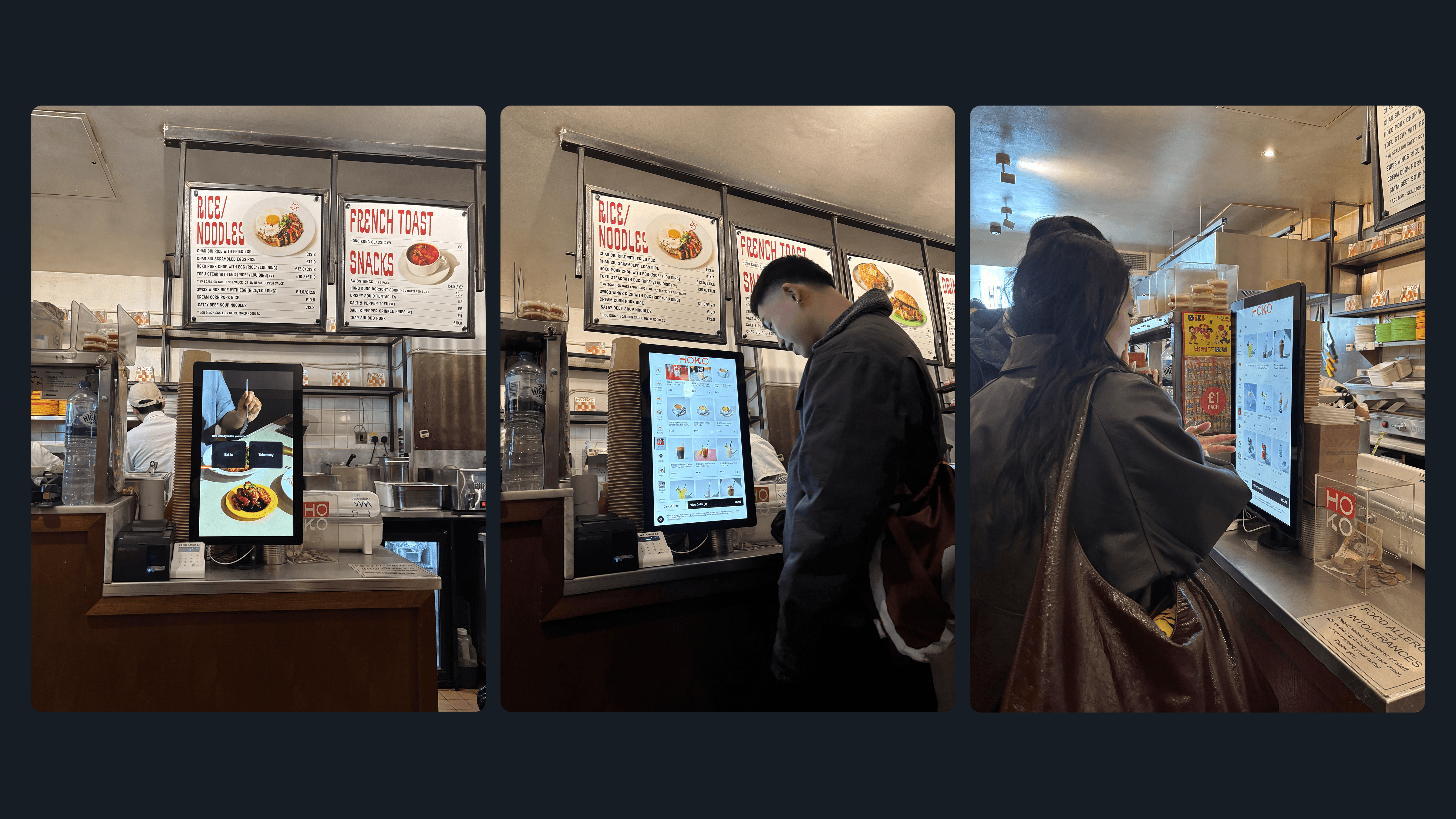
The kiosk was slow and generic The MVP was built on SumUp's B2B POS design system, never designed with kiosk use cases in mind. Touch targets were too small, and without merchant branding, every kiosk looked like it belonged to SumUp - the same black and white UI regardless of whether you were ordering at a coffee shop or a burger restaurant. Consumers spent 4.2 minutes per order on average, creating queues at peak. There were no existing payment patterns for kiosk either, which meant PIX for Brazil had to be designed from scratch.
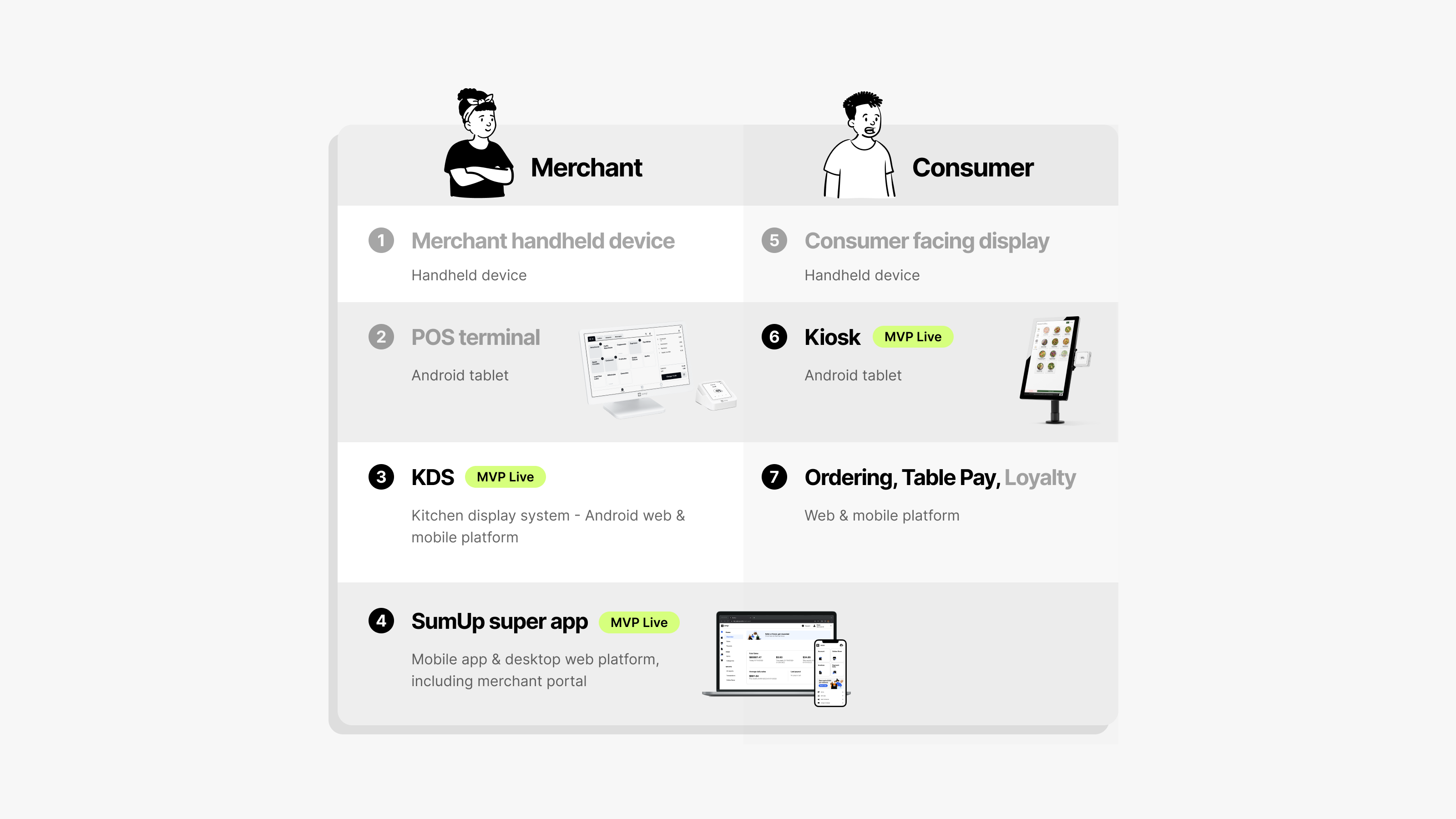
The ecosystem was fragmented Kiosk, portal, KDS, and kitchen slips were built independently. Third-party KDS software added licensing costs and inconsistent workflows, making the system expensive to operate and difficult to scale.
Prioritisation
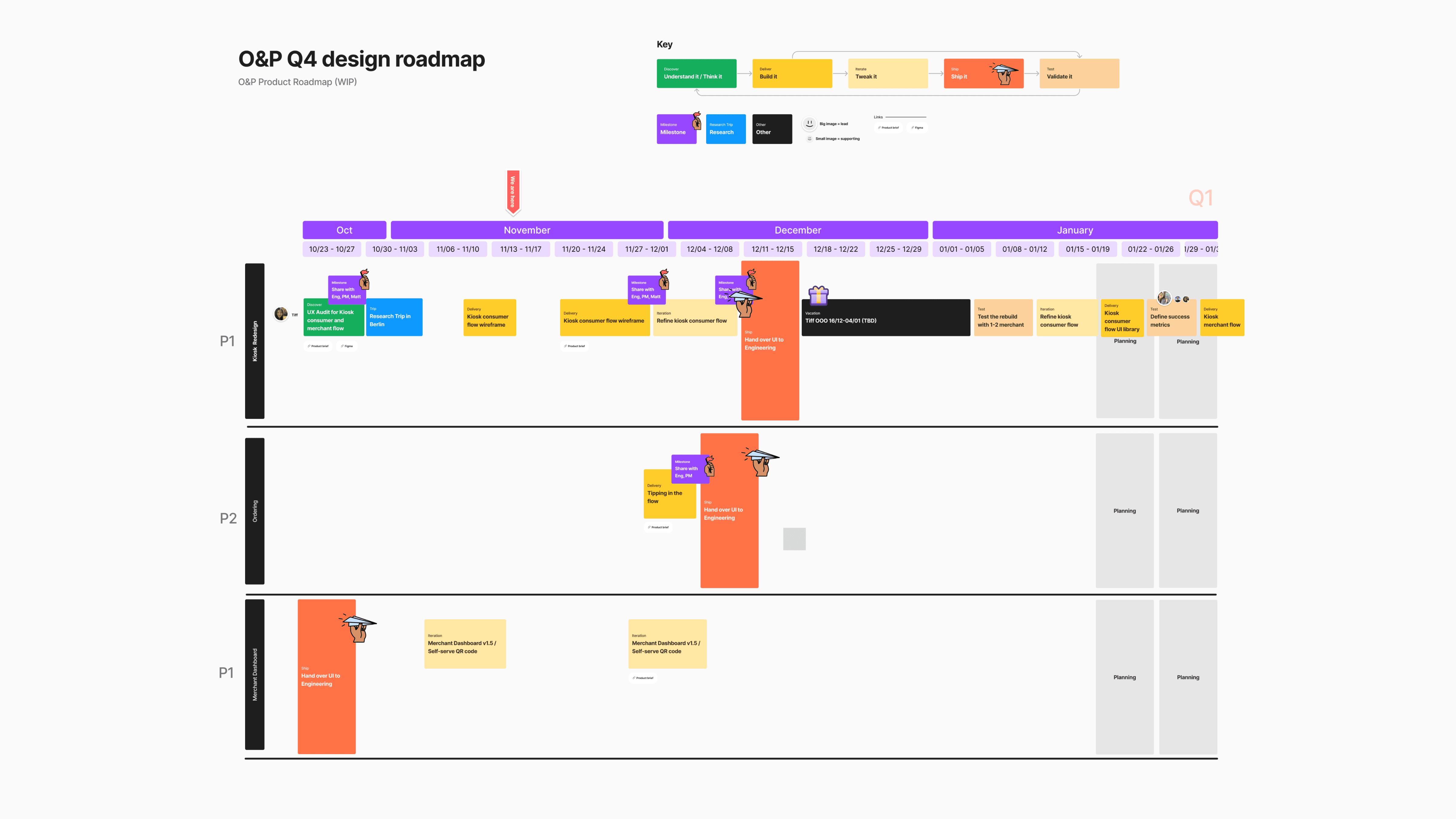
When I joined, all 3 workstreams were treated as equal priorities. I mapped design effort and risk across each and proposed a sequenced design roadmap to Head of Engineering and Product Manager, who validated it against business direction.
We aligned on Kiosk v1 and Merchant Portal first. These were the two direct merchant decision points: how quickly a merchant could get their kiosk live, and whether the portal gave them everything they needed to manage it independently. KDS was sequenced later, accepting continued third-party licensing costs in the short term. That was deliberate - KDS wasn't the reason merchants chose SumUp. Setup speed and portal usability were. Loyalty was deferred until ordering and onboarding were proven.
When I shared the first kiosk design iteration in December, it gave Product and Engineering the clarity to make a hard call. Upsell and pre-order were de-scoped to protect the core ordering flow and hit Q1. That decision directly enabled the Gong Cha contract.
Design
philosophy
Hospitality is one of the oldest human experiences. The mental models already exist: merchants know how to set up a venue, kitchen staff know how to read a ticket, consumers know how to browse a menu. Every product decision came back to the same question: does this feel faster and clearer than what people already do, or are we asking them to learn something new?
With 3 workstreams running in parallel against a hard Q1 deadline, the easiest path would have been to ship each product independently and reconcile later. I pushed back on that. The kiosk, portal, and KDS had to feel like one product family, same usability standard, same interaction logic, same quality bar, even when that created tension with timeline.
Design solution
Redesigning the kiosk experience with scalable design patterns
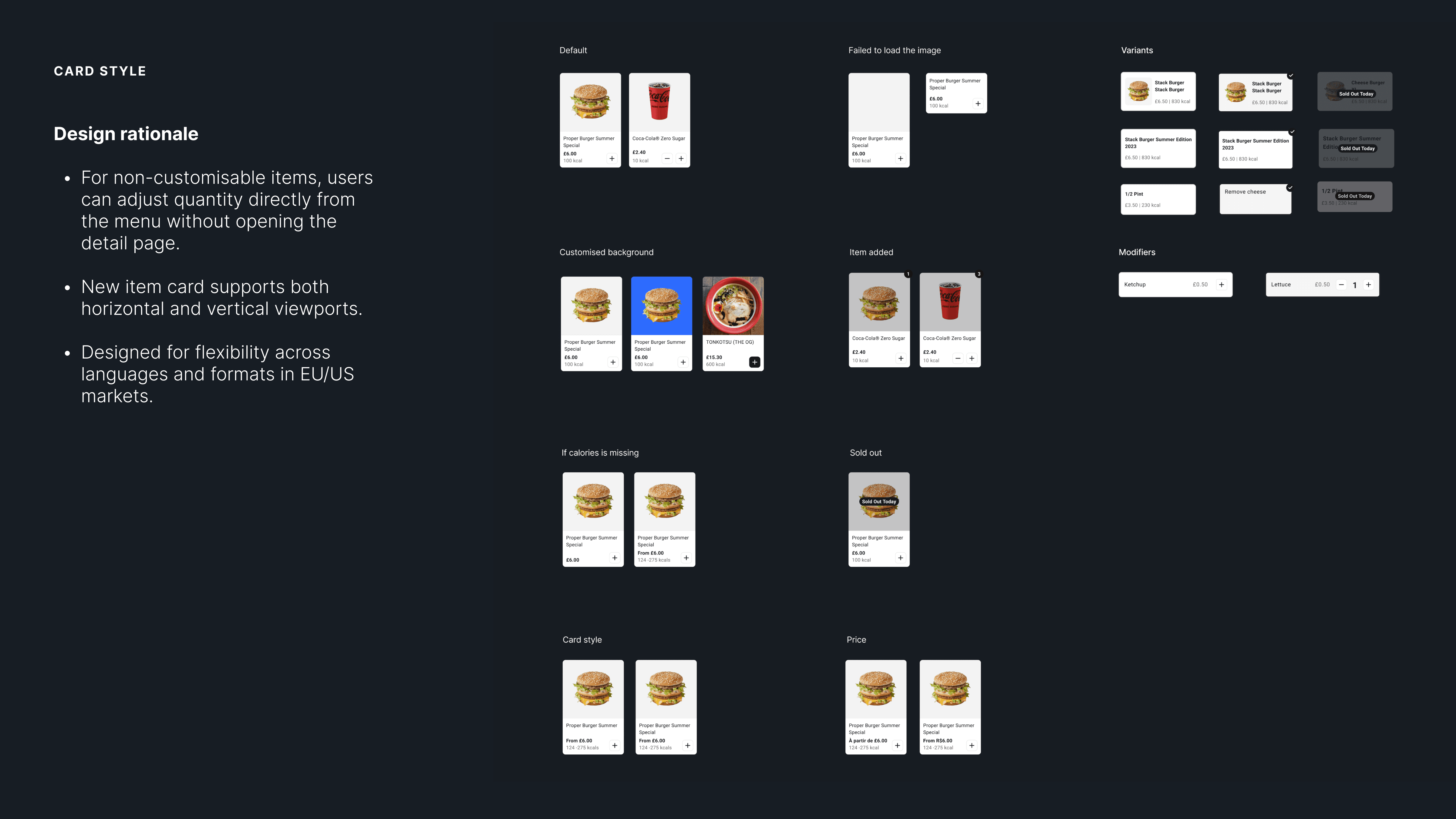
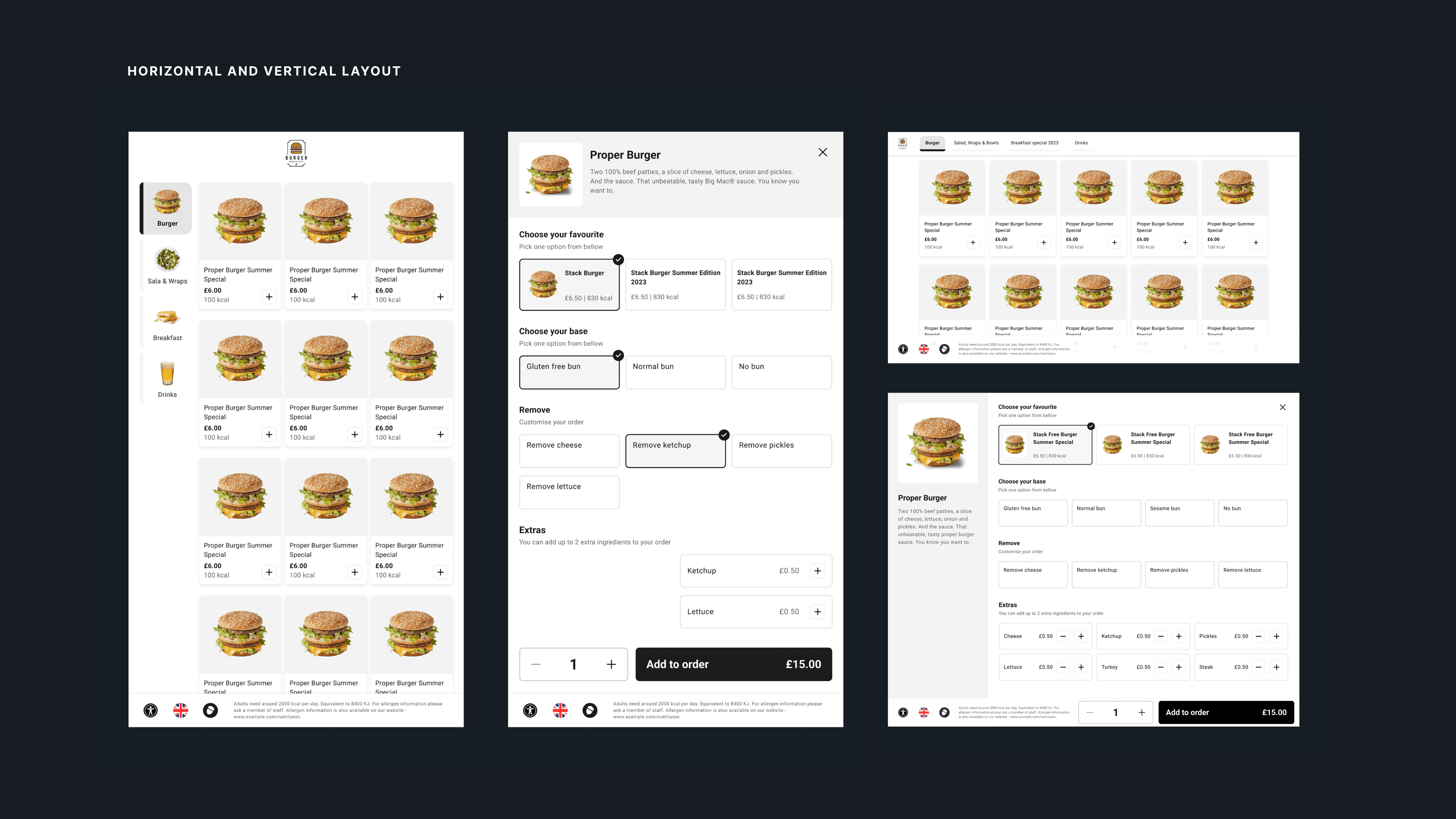
I redesigned the kiosk as a scalable system optimised for speed, clarity, and accessibility. Touch targets were set at a 48px accessibility baseline and physically verified on hardware across actual kiosk viewport sizes, with 720×1280px as the smallest global baseline from merchant hardware profiles.
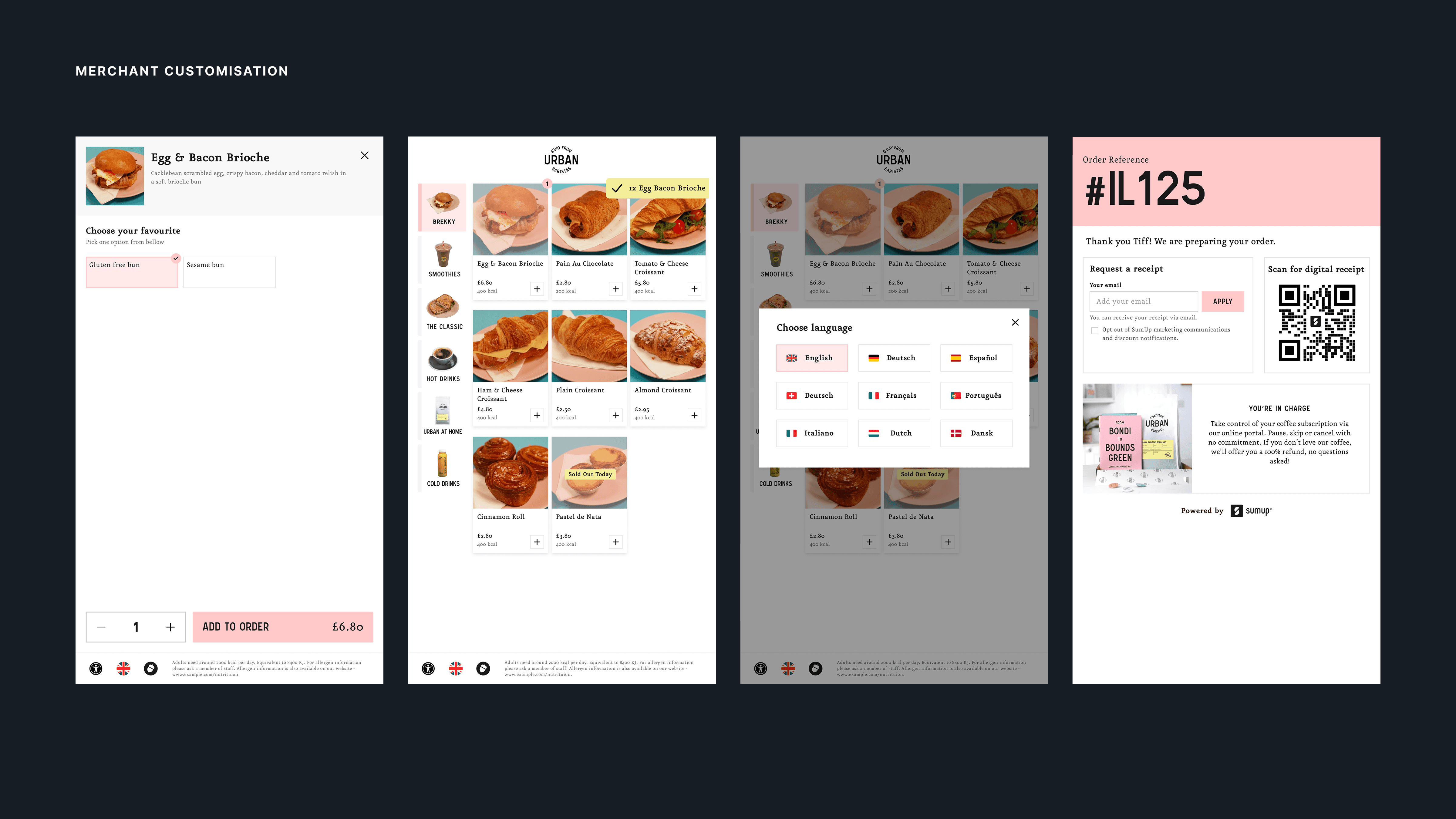
Research across London, Berlin, and NYC revealed that for travellers ordering in a foreign city, the kiosk was the only way to get exactly what they wanted without relying on spoken language. That made multi-language support a product decision, not a localisation checkbox. I worked with Engineering to verify layouts and text hierarchy held across every target language before shipping.
Merchants wanted their brand on the kiosk. The question was how much control to give them. Usability testing showed what happened when touch targets got too small: error rates went up and ordering slowed down. Giving merchants full layout control, including button sizes, would hand them the tools to break the very experience they were paying for. I scoped phase one to font, colour, and logo. Enough to feel like their kiosk. Not enough to hurt their customers.
PIX payment integration
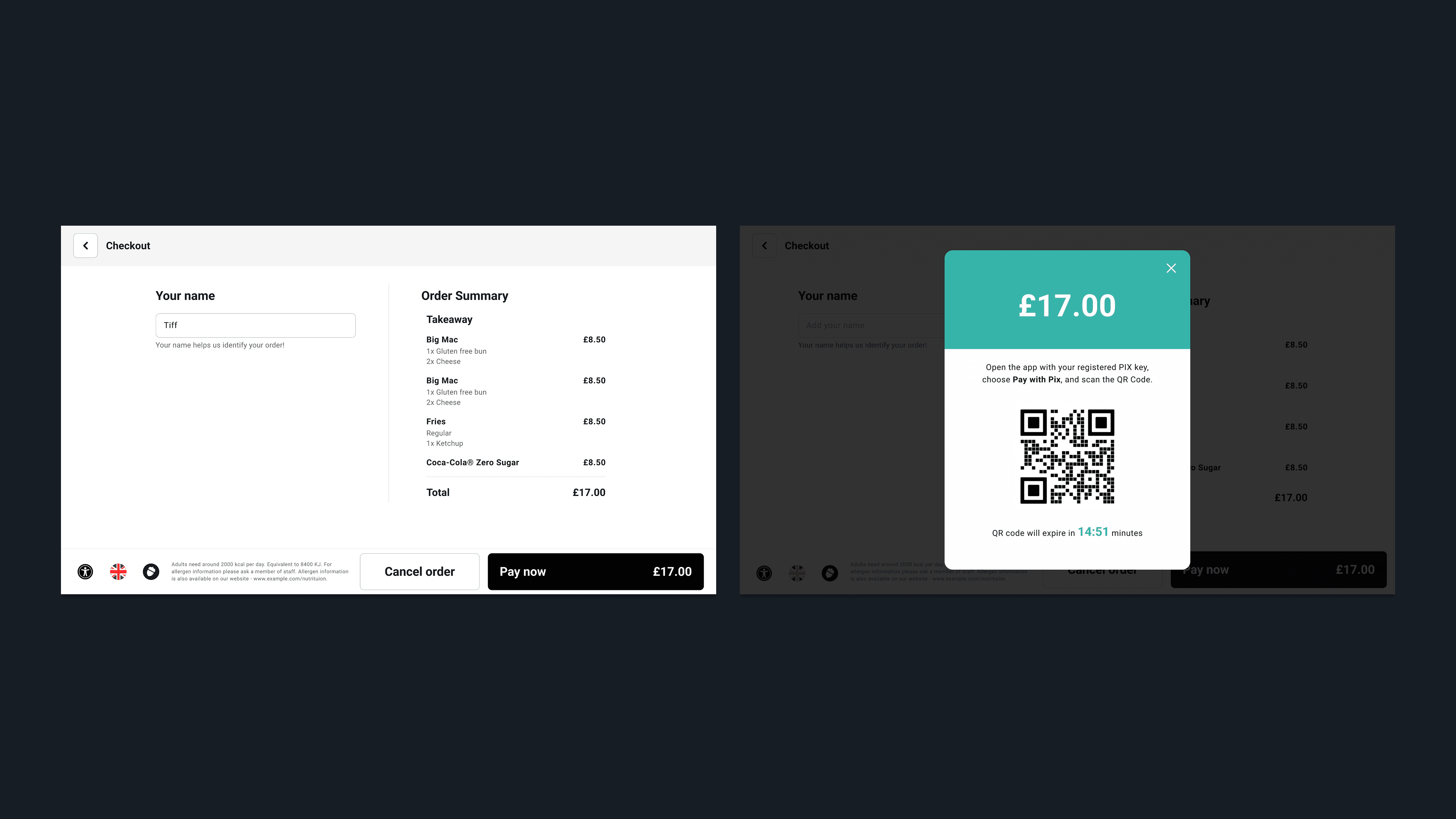
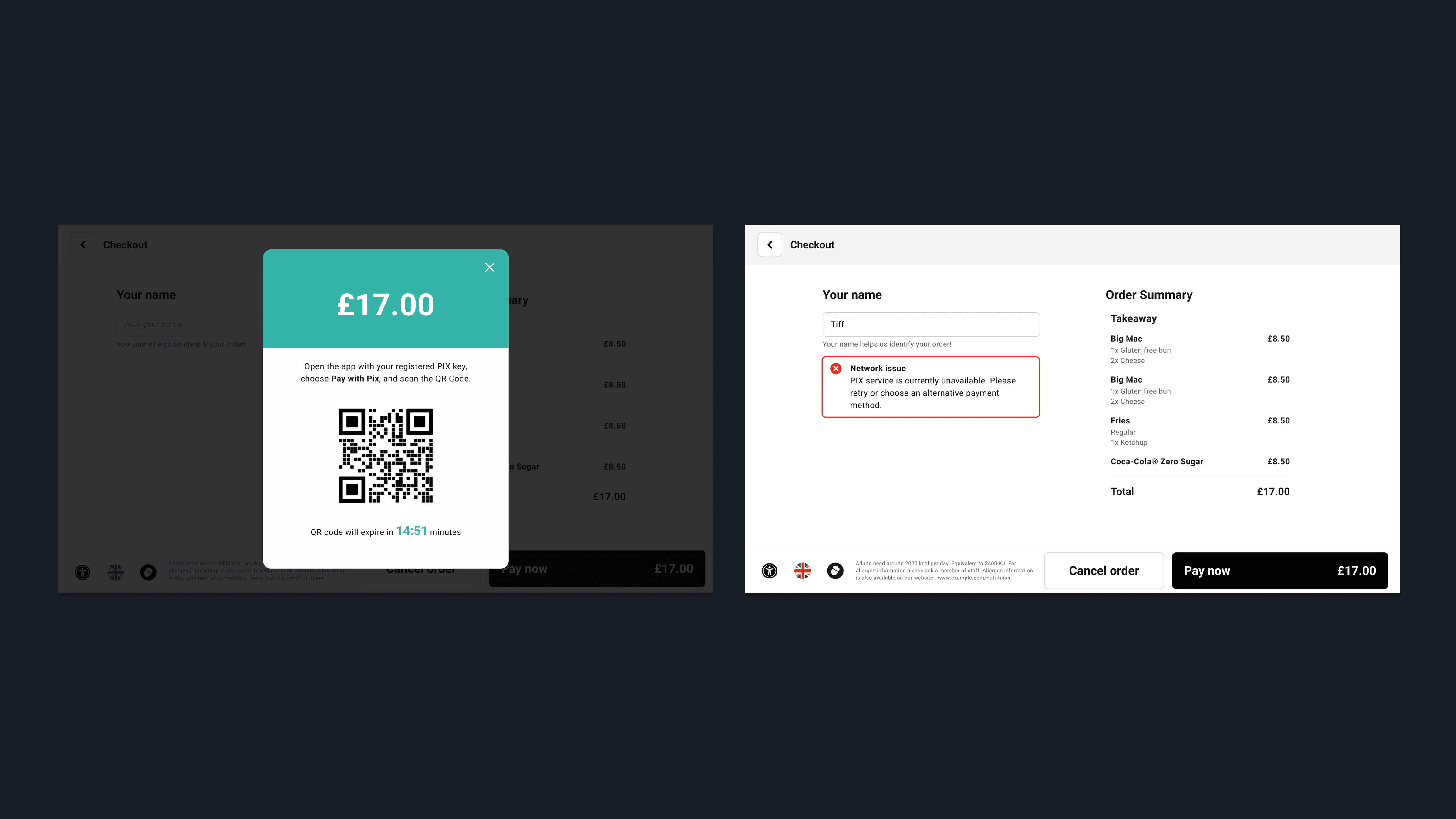
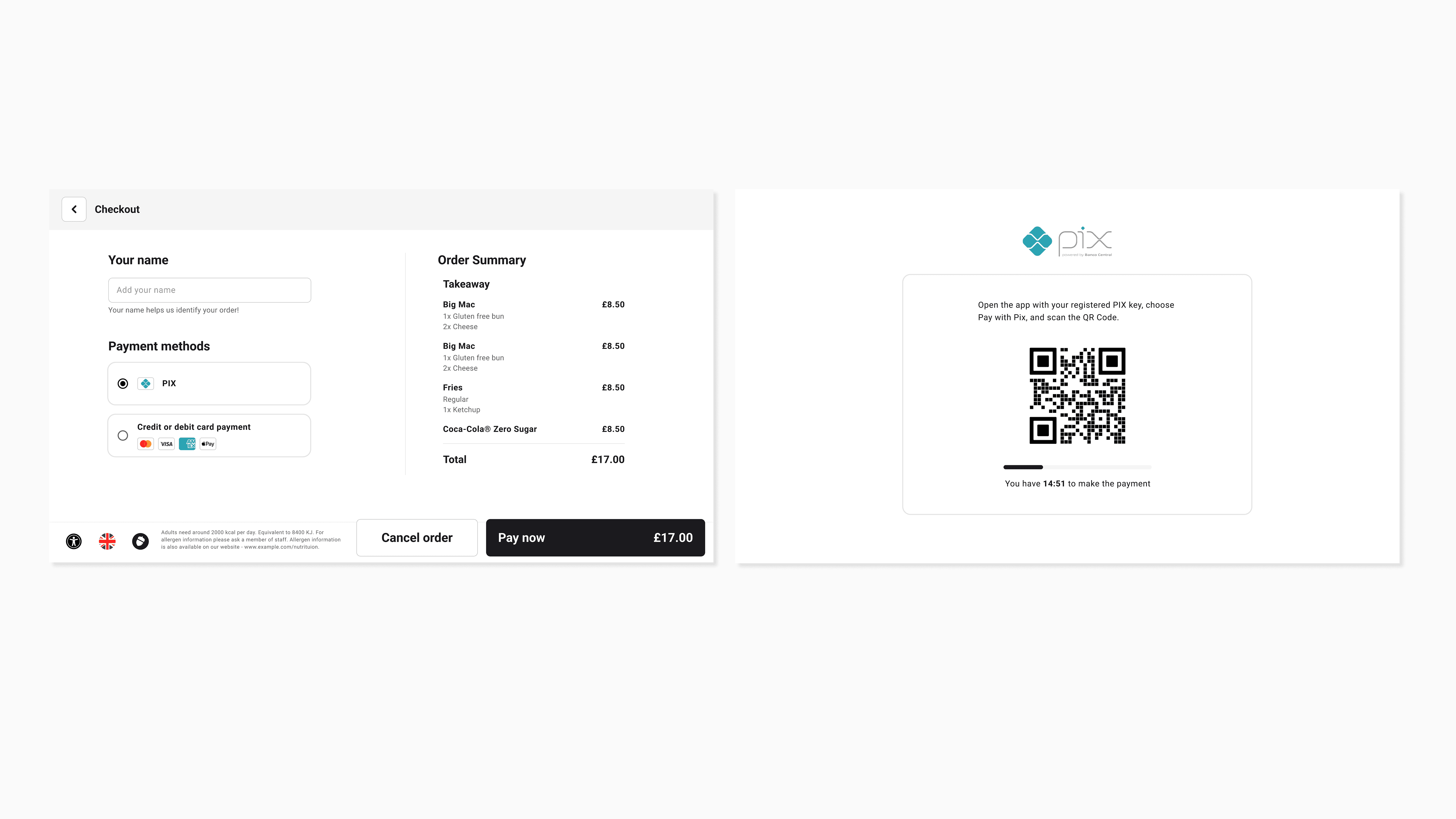
For Brazil, I proposed surfacing payment method selection inline on the checkout page, fewer steps, faster flow. The Staff Engineer pushed back: we couldn't guarantee which payment methods would be available per merchant or market, so displaying them inline risked breaking the UI pattern on the checkout screen. A pop-up was simpler to integrate, giving consumers enough context to complete payment confidently.
The Staff Engineer and I escalated to the Head of Engineering. We aligned on the goal, PIX live for Q2 Brazil launch, and agreed on a pop-up pattern first. Faster to ship, lower risk, extensible later. I accepted one extra consumer step in exchange for a solution that worked within the real constraints of the Brazil rollout.
With no existing PIX completion pattern to build on, I worked with the Staff Engineer to map every payment state from scratch, including success, failure, network issues, unavailable service, and timeout - designing a QR code display with countdown timer and clear recovery flows for a consumer standing at a kiosk with a queue behind them.

Redesigning the merchant onboarding experience
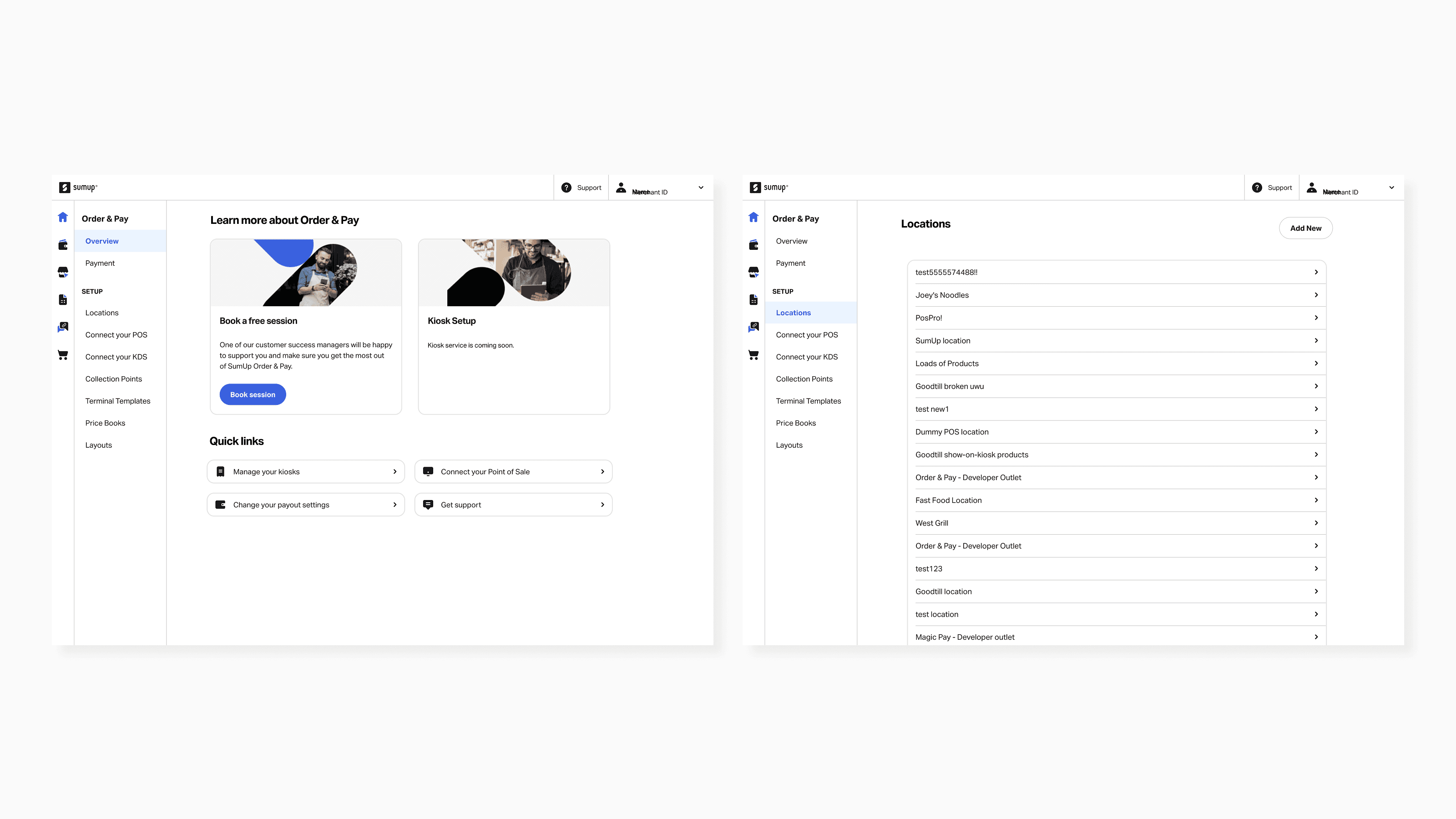
The original portal had no setup sequence. Product was absent from this workstream, so I owned it end-to-end, running competitor research, leading workshops with backend engineers, and proposing the entire structure myself.
Engineers defaulted to technical language throughout. "Terminal" for the kiosk. "Configure" for setup. I reframed every label around what merchants actually recognise: "terminal" became "Kiosk Template", "configure" became "Create." Tested with merchants and Ops managers before it went near development. The engineers came in thinking clarity meant technical accuracy. They left understanding it means immediate recognition.
I defined a 5-step guided flow covering only what was needed to get a kiosk live. Five is the upper limit of what cognitive load research shows users can complete without losing momentum. I worked with backend engineers to identify mandatory fields and pre-fill existing merchant data wherever possible, so merchants reviewed rather than re-entered. The goal was a first working kiosk fast enough to build confidence, not a complete setup that stalled into a support queue.
Redesigning the KDS and kitchen slip
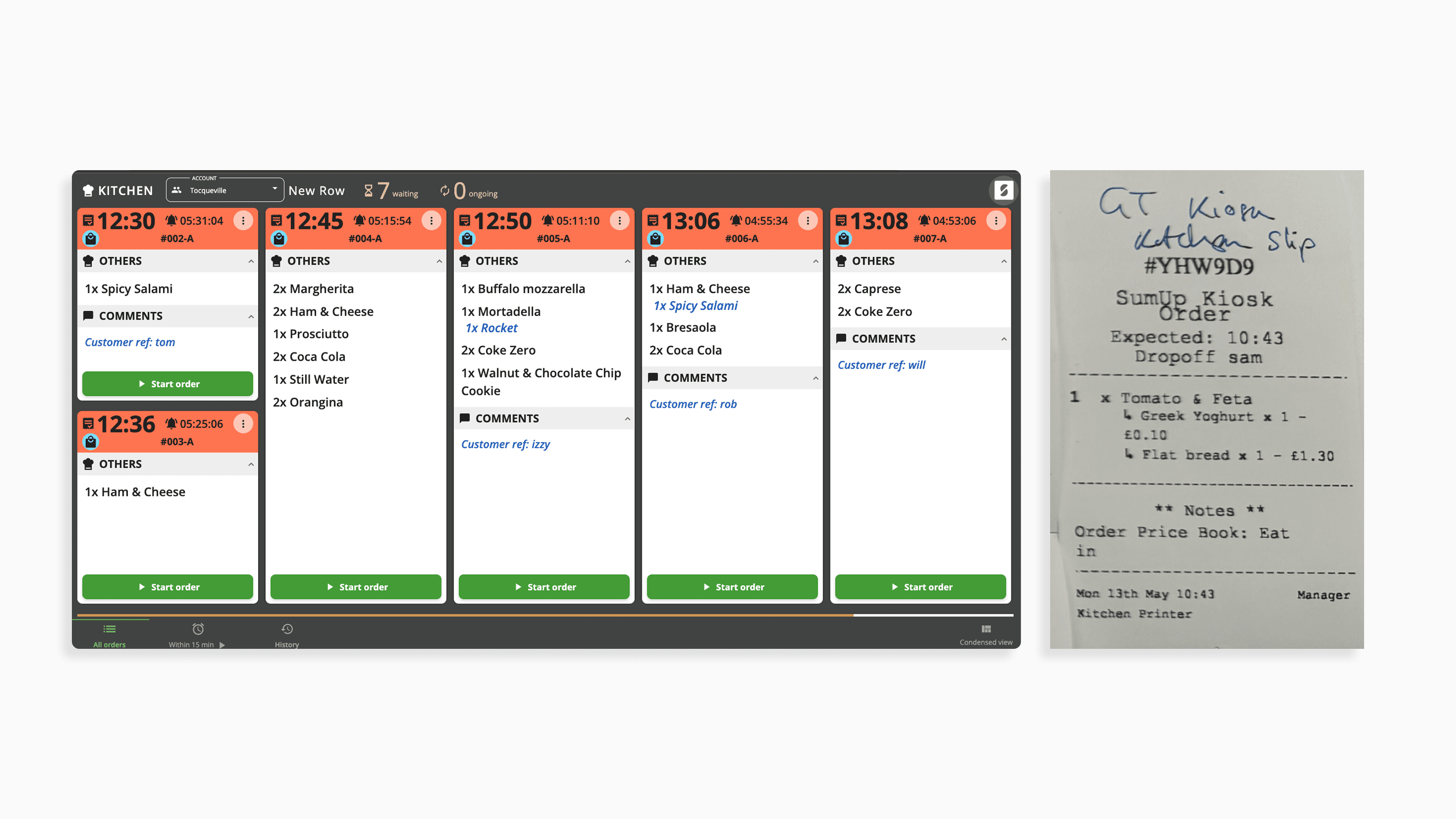
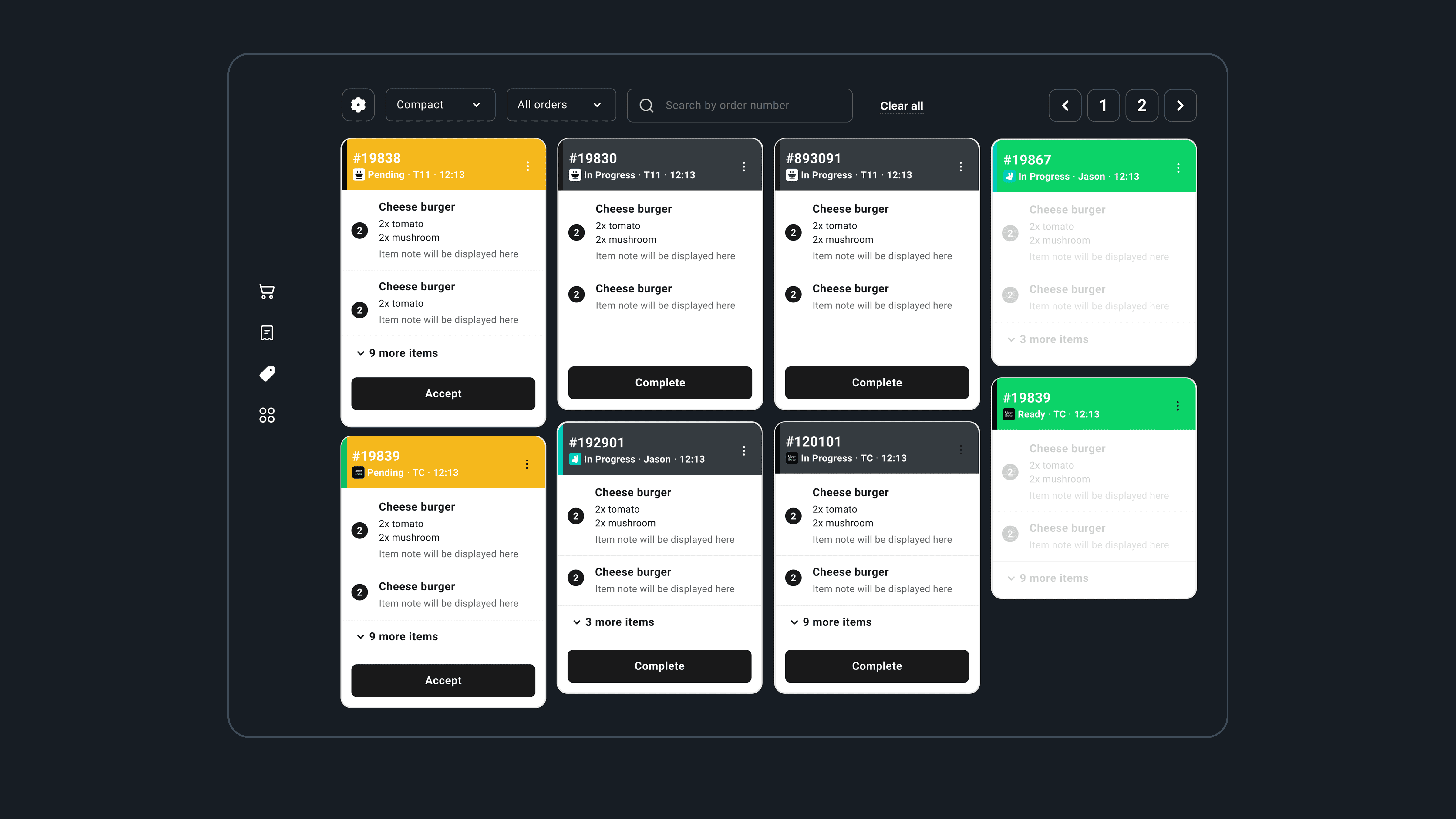
I redesigned the KDS to replace third-party software and surface ticket stages clearly across in-store, delivery, and kiosk orders, mirroring how kitchen staff already think about order flow.
Kitchens operate in low-light environments. High contrast alone causes eye strain over long shifts. Dark mode using the design system's colour scheme is easier to sustain across a full service. The design system had draft components but no validated use case. I worked with the Design System team to document KDS requirements and drive proper token support. KDS became the foundation for dark mode scaling across the wider system.
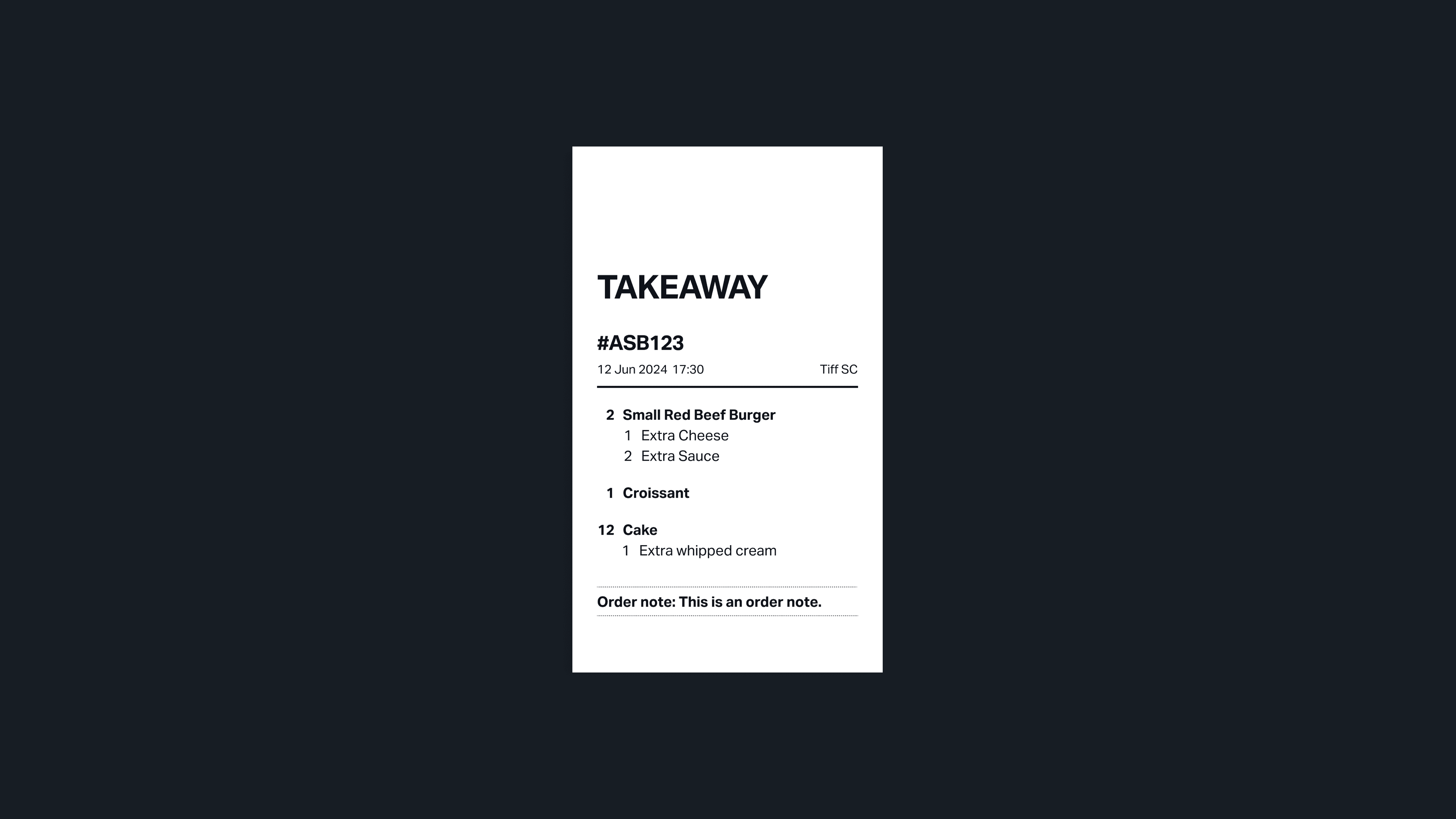
I also redesigned the kitchen slip, refining typography, hierarchy, and spacing to reduce preparation errors.
Outcome
Merchant onboarding dropped from 4 weeks to 5 days. Consumer ordering time fell from 4.2 mins to 2.2 mins, 190k+ monthly orders, 1M+ transactions, 100%+ quarter-over-quarter kiosk sales growth, £200K annual ops cost avoided. Live across UK, France, Italy, Germany, US, and Brazil.
At enterprise scale, Gong Cha deployed across 400+ stores in the Americas. 51.82% of sales through the kiosk, average transaction up $1 from add-ons. When the ordering experience is clear and unhurried, consumers make better decisions for themselves.
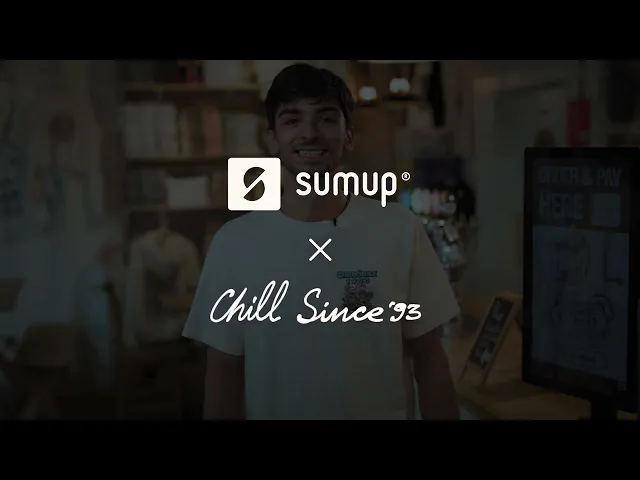
Alfonso Sarracino, manager of Chill Since 93': "Instead of spending time taking orders, our staff has been focused on preparation and customer service. It's made a huge difference and massively reduced queues at peak." Not replace hospitality. Remove the friction that got in the way of it.
Reflection
Merchants without professional food photography paid £600 to £800 per setup for photo support. I explored AI-generated menu photography during hack days as a way to eliminate that cost entirely. Quality wasn't viable then. Given how fast image generation has moved, it's worth revisiting - it could remove one of the last remaining barriers to truly self-serve onboarding.
As the sole designer across 3 workstreams, I built the design-led practice: establishing the process, introducing design QA, and setting a quality bar that kept the work consistent even when product was absent and engineering moved fast. Design led direction rather than followed it, and that shift changed how the team worked.
Summary
SumUp's hospitality products launched as separate MVPs: the kiosk, merchant portal, and kitchen display system(KDS). Merchants waited 3 to 4 weeks for Ops-led installation, had no branding or localisation options, and operated across a fragmented ecosystem. This blocked £2 to £3M in annual revenue from UK, EU, US, and Brazil expansion.
As Design Lead, I owned the end-to-end redesign across all 3 products and proposed the B2B2C design system direction to the SVP of Design.
Outcome: Onboarding reduced from 4 weeks to 5 days. Consumer ordering time dropped from 4.2 to 2.2 minutes. 190k+ monthly orders, 1M+ transactions, 100%+ QoQ kiosk sales growth, £200K annual ops cost avoided.
Problems
Merchants couldn't onboard without help No setup sequence in the portal meant merchants relied on SumUp's Ops managers for phone calls and on-site visits. 3 to 4 week waits at £600 to £1,200 ops cost each. This blocked scale and created churn risk in the UK.
The kiosk was slow and generic The MVP was built on SumUp's B2B POS design system, never designed with kiosk use cases in mind. Touch targets were too small, and without merchant branding, every kiosk looked like it belonged to SumUp - the same black and white UI regardless of whether you were ordering at a coffee shop or a burger restaurant. Consumers spent 4.2 minutes per order on average, creating queues at peak. There were no existing payment patterns for kiosk either, which meant PIX for Brazil had to be designed from scratch.
The ecosystem was fragmented Kiosk, portal, KDS, and kitchen slips were built independently. Third-party KDS software added licensing costs and inconsistent workflows, making the system expensive to operate and difficult to scale.
Design philosophy
Hospitality is one of the oldest human experiences. The mental models already exist: merchants know how to set up a venue, kitchen staff know how to read a ticket, consumers know how to browse a menu. Every product decision came back to the same question: does this feel faster and clearer than what people already do, or are we asking them to learn something new?
With 3 workstreams running in parallel against a hard Q1 deadline, the easiest path would have been to ship each product independently and reconcile later. I pushed back on that. The kiosk, portal, and KDS had to feel like one product family, same usability standard, same interaction logic, same quality bar, even when that created tension with timeline.
Redesigning the merchant onboarding experience
The original portal had no setup sequence. Product was absent from this workstream, so I owned it end-to-end, running competitor research, leading workshops with backend engineers, and proposing the entire structure myself.
Engineers defaulted to technical language throughout. "Terminal" for the kiosk. "Configure" for setup. I reframed every label around what merchants actually recognise: "terminal" became "Kiosk Template", "configure" became "Create." Tested with merchants and Ops managers before it went near development. The engineers came in thinking clarity meant technical accuracy. They left understanding it means immediate recognition.
I defined a 5-step guided flow covering only what was needed to get a kiosk live. Five is the upper limit of what cognitive load research shows users can complete without losing momentum. I worked with backend engineers to identify mandatory fields and pre-fill existing merchant data wherever possible, so merchants reviewed rather than re-entered. The goal was a first working kiosk fast enough to build confidence, not a complete setup that stalled into a support queue.
Design solution
Redesigning the kiosk experience with scalable design patterns
I redesigned the kiosk as a scalable system optimised for speed, clarity, and accessibility. Touch targets were set at a 48px accessibility baseline and physically verified on hardware across actual kiosk viewport sizes, with 720×1280px as the smallest global baseline from merchant hardware profiles.
Research across London, Berlin, and NYC revealed that for travellers ordering in a foreign city, the kiosk was the only way to get exactly what they wanted without relying on spoken language. That made multi-language support a product decision, not a localisation checkbox. I worked with Engineering to verify layouts and text hierarchy held across every target language before shipping.
Merchants wanted their brand on the kiosk. The question was how much control to give them. Usability testing showed what happened when touch targets got too small: error rates went up and ordering slowed down. Giving merchants full layout control, including button sizes, would hand them the tools to break the very experience they were paying for. I scoped phase one to font, colour, and logo. Enough to feel like their kiosk. Not enough to hurt their customers.
Outcome
Merchant onboarding dropped from 4 weeks to 5 days. Consumer ordering time fell from 4.2 mins to 2.2 mins, 190k+ monthly orders, 1M+ transactions, 100%+ quarter-over-quarter kiosk sales growth, £200K annual ops cost avoided. Live across UK, France, Italy, Germany, US, and Brazil.
At enterprise scale, Gong Cha deployed across 400+ stores in the Americas. 51.82% of sales through the kiosk, average transaction up $1 from add-ons. When the ordering experience is clear and unhurried, consumers make better decisions for themselves.
Alfonso Sarracino, manager of Chill Since 93': "Instead of spending time taking orders, our staff has been focused on preparation and customer service. It's made a huge difference and massively reduced queues at peak." Not replace hospitality. Remove the friction that got in the way of it.
Redesigning the KDS and kitchen slip
I redesigned the KDS to replace third-party software and surface ticket stages clearly across in-store, delivery, and kiosk orders, mirroring how kitchen staff already think about order flow.
Kitchens operate in low-light environments. High contrast alone causes eye strain over long shifts. Dark mode using the design system's colour scheme is easier to sustain across a full service. The design system had draft components but no validated use case. I worked with the Design System team to document KDS requirements and drive proper token support. KDS became the foundation for dark mode scaling across the wider system.
I also redesigned the kitchen slip, refining typography, hierarchy, and spacing to reduce preparation errors.
Reflection
Merchants without professional food photography paid £600 to £800 per setup for photo support. I explored AI-generated menu photography during hack days as a way to eliminate that cost entirely. Quality wasn't viable then. Given how fast image generation has moved, it's worth revisiting - it could remove one of the last remaining barriers to truly self-serve onboarding.
As the sole designer across 3 workstreams, I built the design-led practice: establishing the process, introducing design QA, and setting a quality bar that kept the work consistent even when product was absent and engineering moved fast. Design led direction rather than followed it, and that shift changed how the team worked.
PIX payment integration
For Brazil, I proposed surfacing payment method selection inline on the checkout page, fewer steps, faster flow. The Staff Engineer pushed back: we couldn't guarantee which payment methods would be available per merchant or market, so displaying them inline risked breaking the UI pattern on the checkout screen. A pop-up was simpler to integrate, giving consumers enough context to complete payment confidently.
The Staff Engineer and I escalated to the Head of Engineering. We aligned on the goal, PIX live for Q2 Brazil launch, and agreed on a pop-up pattern first. Faster to ship, lower risk, extensible later. I accepted one extra consumer step in exchange for a solution that worked within the real constraints of the Brazil rollout.
With no existing PIX completion pattern to build on, I worked with the Staff Engineer to map every payment state from scratch — success, failure, network issues, unavailable service, and timeout — designing a QR code display with countdown timer and clear recovery flows for a consumer standing at a kiosk with a queue behind them.
Prioritisation
When I joined, all 3 workstreams were treated as equal priorities. I mapped design effort and risk across each and proposed a sequenced design roadmap to Head of Engineering and Product Manager, who validated it against business direction.
We aligned on Kiosk v1 and Merchant Portal first. These were the two direct merchant decision points: how quickly a merchant could get their kiosk live, and whether the portal gave them everything they needed to manage it independently. KDS was sequenced later, accepting continued third-party licensing costs in the short term. That was deliberate - KDS wasn't the reason merchants chose SumUp. Setup speed and portal usability were. Loyalty was deferred until ordering and onboarding were proven.
When I shared the first kiosk design iteration in December, it gave Product and Engineering the clarity to make a hard call. Upsell and pre-order were de-scoped to protect the core ordering flow and hit Q1. That decision directly enabled the Gong Cha contract.
Summary
SumUp's hospitality products launched as separate MVPs: the kiosk, merchant portal, and kitchen display system(KDS). Merchants waited 3 to 4 weeks for Ops-led installation, had no branding or localisation options, and operated across a fragmented ecosystem. This blocked £2 to £3M in annual revenue from UK, EU, US, and Brazil expansion.
As Design Lead, I owned the end-to-end redesign across all 3 products and proposed the B2B2C design system direction to the SVP of Design.
Outcome: Onboarding reduced from 4 weeks to 5 days. Consumer ordering time dropped from 4.2 to 2.2 minutes. 190k+ monthly orders, 1M+ transactions, 100%+ QoQ kiosk sales growth, £200K annual ops cost avoided.
Problems
Merchants couldn't onboard without help No setup sequence in the portal meant merchants relied on SumUp's Ops managers for phone calls and on-site visits. 3 to 4 week waits at £600 to £1,200 ops cost each. This blocked scale and created churn risk in the UK.
The kiosk was slow and generic The MVP was built on SumUp's B2B POS design system, never designed with kiosk use cases in mind. Touch targets were too small, and without merchant branding, every kiosk looked like it belonged to SumUp - the same black and white UI regardless of whether you were ordering at a coffee shop or a burger restaurant. Consumers spent 4.2 minutes per order on average, creating queues at peak. There were no existing payment patterns for kiosk either, which meant PIX for Brazil had to be designed from scratch.
The ecosystem was fragmented Kiosk, portal, KDS, and kitchen slips were built independently. Third-party KDS software added licensing costs and inconsistent workflows, making the system expensive to operate and difficult to scale.
Prioritisation
When I joined, all 3 workstreams were treated as equal priorities. I mapped design effort and risk across each and proposed a sequenced design roadmap to Head of Engineering and Product Manager, who validated it against business direction.
We aligned on Kiosk v1 and Merchant Portal first. These were the two direct merchant decision points: how quickly a merchant could get their kiosk live, and whether the portal gave them everything they needed to manage it independently. KDS was sequenced later, accepting continued third-party licensing costs in the short term. That was deliberate - KDS wasn't the reason merchants chose SumUp. Setup speed and portal usability were. Loyalty was deferred until ordering and onboarding were proven.
When I shared the first kiosk design iteration in December, it gave Product and Engineering the clarity to make a hard call. Upsell and pre-order were de-scoped to protect the core ordering flow and hit Q1. That decision directly enabled the Gong Cha contract.
Design philosophy
Hospitality is one of the oldest human experiences. The mental models already exist: merchants know how to set up a venue, kitchen staff know how to read a ticket, consumers know how to browse a menu. Every product decision came back to the same question: does this feel faster and clearer than what people already do, or are we asking them to learn something new?
With 3 workstreams running in parallel against a hard Q1 deadline, the easiest path would have been to ship each product independently and reconcile later. I pushed back on that. The kiosk, portal, and KDS had to feel like one product family, same usability standard, same interaction logic, same quality bar, even when that created tension with timeline.
PIX payment integration
For Brazil, I proposed surfacing payment method selection inline on the checkout page, fewer steps, faster flow. The Staff Engineer pushed back: we couldn't guarantee which payment methods would be available per merchant or market, so displaying them inline risked breaking the UI pattern on the checkout screen. A pop-up was simpler to integrate, giving consumers enough context to complete payment confidently.
The Staff Engineer and I escalated to the Head of Engineering. We aligned on the goal, PIX live for Q2 Brazil launch, and agreed on a pop-up pattern first. Faster to ship, lower risk, extensible later. I accepted one extra consumer step in exchange for a solution that worked within the real constraints of the Brazil rollout.
With no existing PIX completion pattern to build on, I worked with the Staff Engineer to map every payment state from scratch — success, failure, network issues, unavailable service, and timeout — designing a QR code display with countdown timer and clear recovery flows for a consumer standing at a kiosk with a queue behind them.
Design solution
Redesigning the kiosk experience with scalable design patterns
I redesigned the kiosk as a scalable system optimised for speed, clarity, and accessibility. Touch targets were set at a 48px accessibility baseline and physically verified on hardware across actual kiosk viewport sizes, with 720×1280px as the smallest global baseline from merchant hardware profiles.
Research across London, Berlin, and NYC revealed that for travellers ordering in a foreign city, the kiosk was the only way to get exactly what they wanted without relying on spoken language. That made multi-language support a product decision, not a localisation checkbox. I worked with Engineering to verify layouts and text hierarchy held across every target language before shipping.
Merchants wanted their brand on the kiosk. The question was how much control to give them. Usability testing showed what happened when touch targets got too small: error rates went up and ordering slowed down. Giving merchants full layout control, including button sizes, would hand them the tools to break the very experience they were paying for. I scoped phase one to font, colour, and logo. Enough to feel like their kiosk. Not enough to hurt their customers.
Redesigning the KDS and kitchen slip
I redesigned the KDS to replace third-party software and surface ticket stages clearly across in-store, delivery, and kiosk orders, mirroring how kitchen staff already think about order flow.
Kitchens operate in low-light environments. High contrast alone causes eye strain over long shifts. Dark mode using the design system's colour scheme is easier to sustain across a full service. The design system had draft components but no validated use case. I worked with the Design System team to document KDS requirements and drive proper token support. KDS became the foundation for dark mode scaling across the wider system.
I also redesigned the kitchen slip, refining typography, hierarchy, and spacing to reduce preparation errors.
Reflection
Merchants without professional food photography paid £600 to £800 per setup for photo support. I explored AI-generated menu photography during hack days as a way to eliminate that cost entirely. Quality wasn't viable then. Given how fast image generation has moved, it's worth revisiting - it could remove one of the last remaining barriers to truly self-serve onboarding.
As the sole designer across 3 workstreams, I built the design-led practice: establishing the process, introducing design QA, and setting a quality bar that kept the work consistent even when product was absent and engineering moved fast. Design led direction rather than followed it, and that shift changed how the team worked.
Outcome
Merchant onboarding dropped from 4 weeks to 5 days. Consumer ordering time fell from 4.2 mins to 2.2 mins, 190k+ monthly orders, 1M+ transactions, 100%+ quarter-over-quarter kiosk sales growth, £200K annual ops cost avoided. Live across UK, France, Italy, Germany, US, and Brazil.
At enterprise scale, Gong Cha deployed across 400+ stores in the Americas. 51.82% of sales through the kiosk, average transaction up $1 from add-ons. When the ordering experience is clear and unhurried, consumers make better decisions for themselves.
Alfonso Sarracino, manager of Chill Since 93': "Instead of spending time taking orders, our staff has been focused on preparation and customer service. It's made a huge difference and massively reduced queues at peak." Not replace hospitality. Remove the friction that got in the way of it.
Redesigning the merchant onboarding experience
The original portal had no setup sequence. Product was absent from this workstream, so I owned it end-to-end, running competitor research, leading workshops with backend engineers, and proposing the entire structure myself.
Engineers defaulted to technical language throughout. "Terminal" for the kiosk. "Configure" for setup. I reframed every label around what merchants actually recognise: "terminal" became "Kiosk Template", "configure" became "Create." Tested with merchants and Ops managers before it went near development. The engineers came in thinking clarity meant technical accuracy. They left understanding it means immediate recognition.
I defined a 5-step guided flow covering only what was needed to get a kiosk live. Five is the upper limit of what cognitive load research shows users can complete without losing momentum. I worked with backend engineers to identify mandatory fields and pre-fill existing merchant data wherever possible, so merchants reviewed rather than re-entered. The goal was a first working kiosk fast enough to build confidence, not a complete setup that stalled into a support queue.
Other projects

Designing Content Moderation & Appeals at Scale
Designing Content Moderation & Appeals at Scale
Cut moderation handling time by 50% and built a 0→1 appeals service that enabled scalable, DSA-compliant growth.
Cut moderation handling time by 50% and built a 0→1 appeals service that enabled scalable, DSA-compliant growth.
Reimagining BBFC’s Film Classification Platform
Cut report writing time by 50% and improved classification accuracy for 10K+ film reviews.