Designing Content Moderation & Appeals at Scale at Spotify
Designing Content Moderation & Appeals at Scale at Spotify
Designing Content Moderation & Appeals at Scale at Spotify
Redesigned Spotify’s moderation system to cut handling time by 50% across 7+ content types, and built a 0→1 appeals service to make enforcement decisions transparent, scalable, and DSA-compliant.
Role
Design Lead
Project type
Moderation Tooling · Appeals · Compliance Workflows
Duration
18-20 months

Summary
Spotify’s content integrity work spans two connected areas: internal moderation tooling used daily by operators, and appeals under the EU Digital Services Act (DSA), which require clear, fair, and auditable end-to-end journeys for consumers and creators.
As Design Lead, I owned the end-to-end design of Monocle and led the DSA Appeals service from 0→1. That meant translating a fragmented operator landscape into a unified platform, and for Appeals, the most challenging part was navigating an ambiguous problem space: with no internal precedent, framing the right problems to solve from evolving legal requirements before Engineering and Legal could build against them.
Outcome: Moderation handling time was reduced by 50%. Monocle became the primary workflow for global operators, replacing 20+ legacy tools. The DSA Appeals service enabled Spotify to meet EU regulatory requirements and improved auditability for transparency reporting.
Key scope
Moderation tooling (Monocle) - global operator team, 20+ internal tools replaced
EU DSA Appeals - 0→1 service design under regulatory ambiguity
Problems
Moderation tooling - Monocle
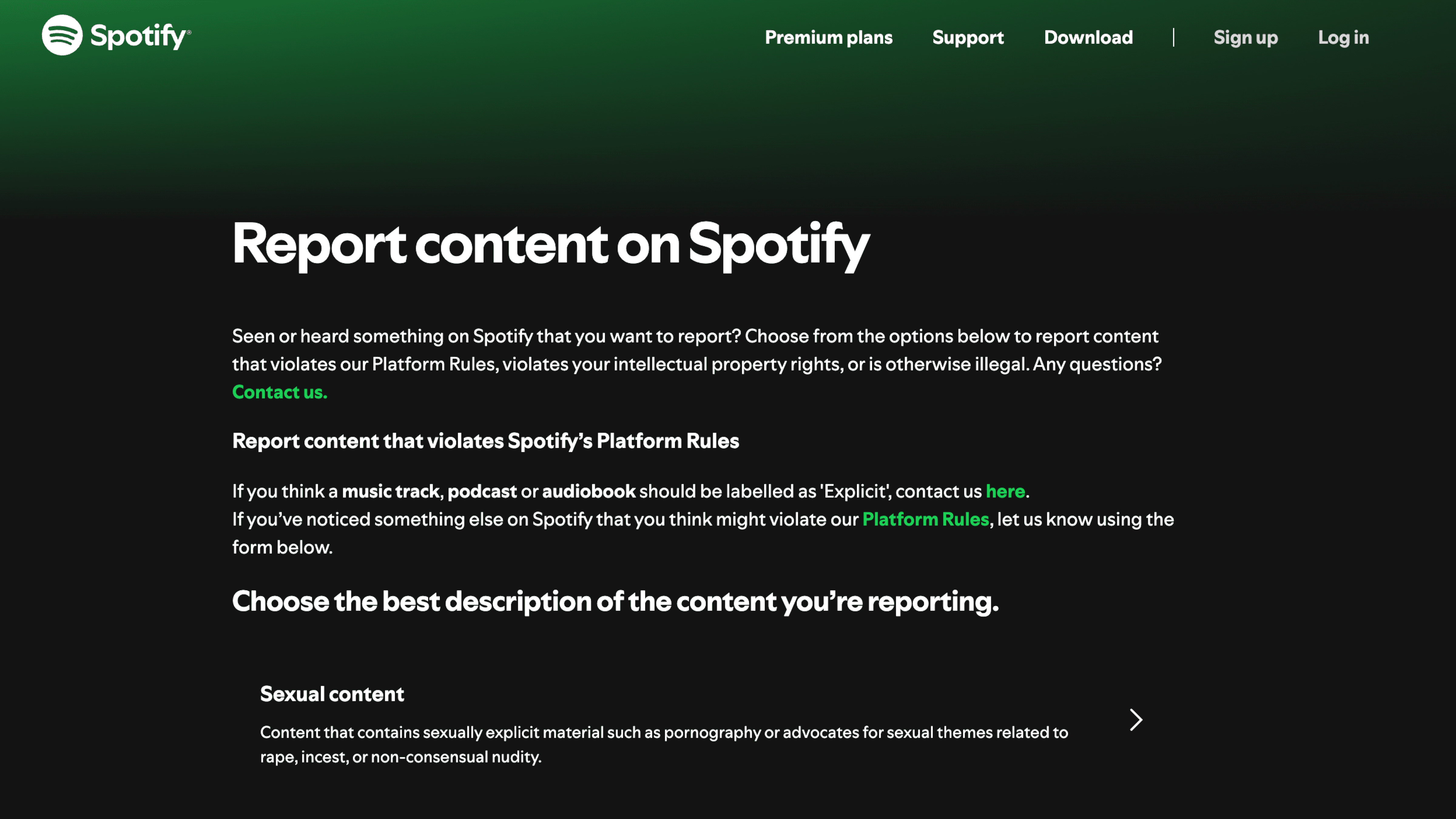
Content moderation relied on 20+ internal tools depending on content type. Review context, policy tagging, enforcement actions, and investigation history were split across systems, forcing constant tool switching.
This increased cognitive load, slowed throughput, and made consistent enforcement difficult at scale. Investigations often required reconstructing decisions from email threads, adding operational overhead. The Monocle MVP supported music only, with no unified review + action workflow for newer content types.
Appeals under EU DSA
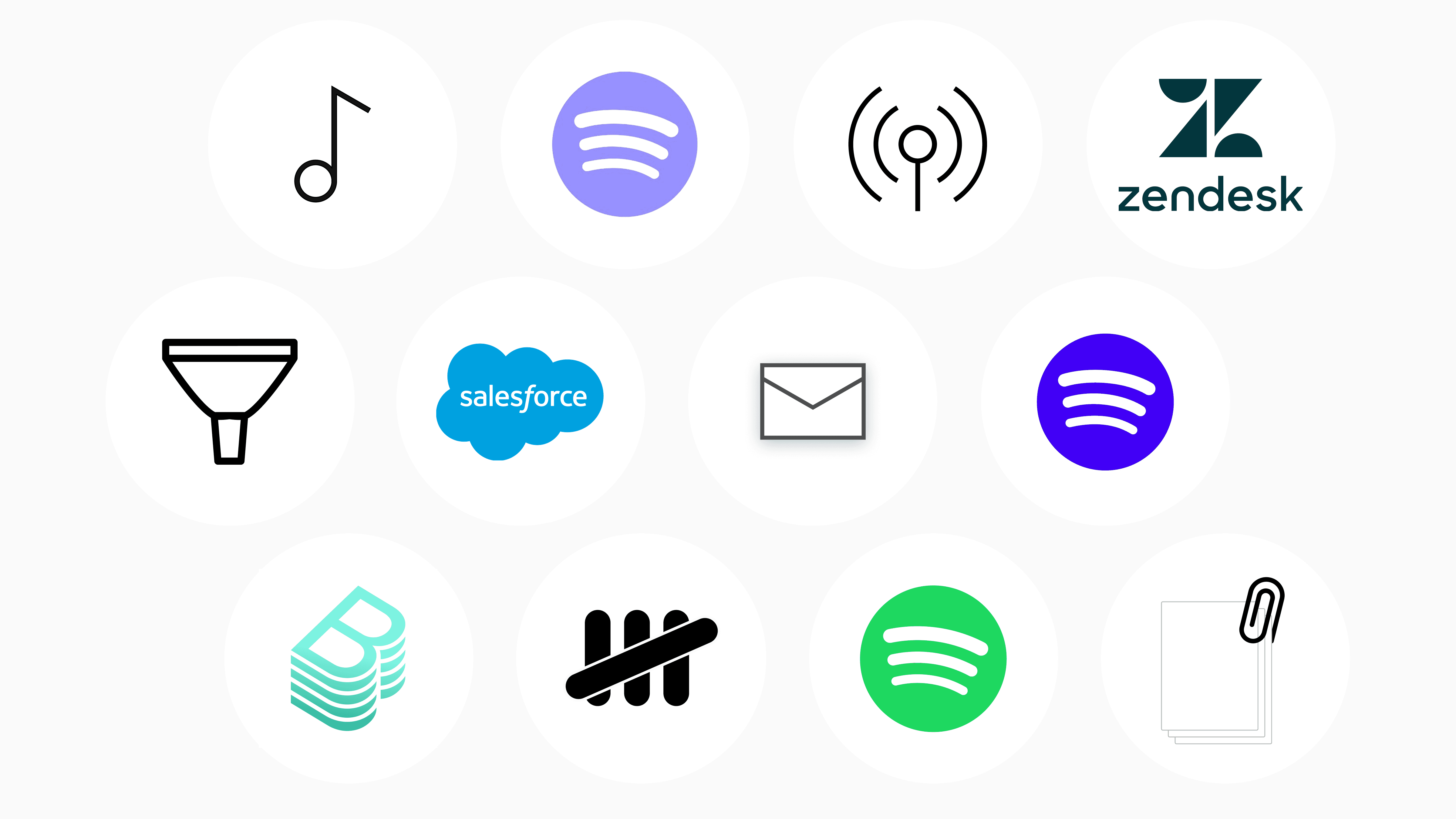
Appeals under EU DSA — 0→1 service design under regulatory ambiguity. Spotify had no existing end-to-end appeals service for non-IP legal violations, and the DSA introduced new obligations without internal precedent.
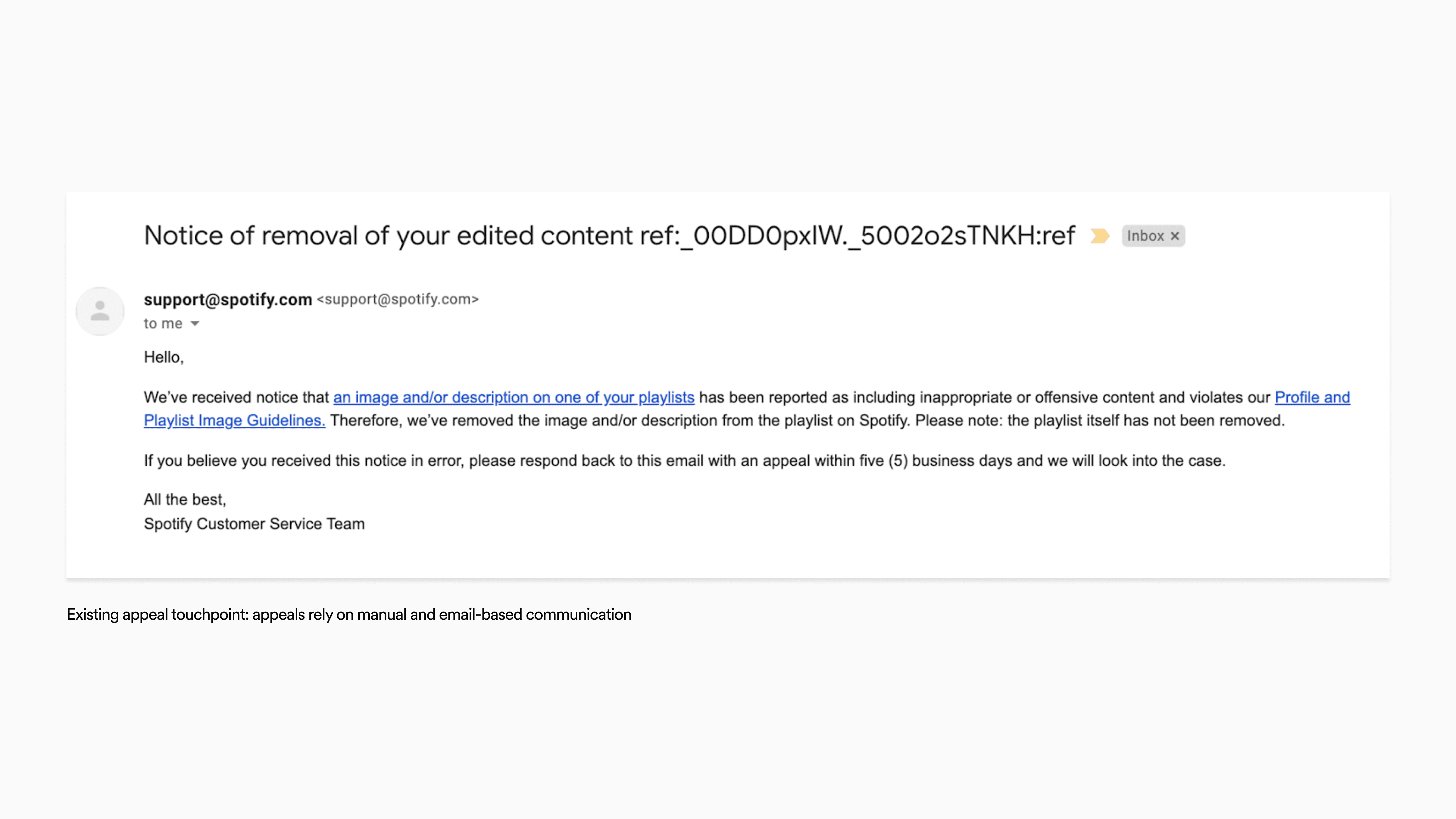
The primary challenge was framing the right problems to solve and translating evolving legal interpretation into concrete product requirements that Design and Engineering could build against. Existing IP appeals relied on manual, email-based workflows with fragmented data, limiting auditability and scalability. With 45M+ EU users, failing to establish a compliant appeals service carried material regulatory and financial risk.
Appeals under EU DSA
Appeals under EU DSA — 0→1 service design under regulatory ambiguity. Spotify had no existing end-to-end appeals service for non-IP legal violations, and the DSA introduced new obligations without internal precedent.
The primary challenge was framing the right problems to solve and translating evolving legal interpretation into concrete product requirements that Design and Engineering could build against. Existing IP appeals relied on manual, email-based workflows with fragmented data, limiting auditability and scalability. With 45M+ EU users, failing to establish a compliant appeals service carried material regulatory and financial risk.
Prioritisation
I worked with Product, Policy, Legal, and Engineering to prioritise based on operational bottlenecks, regulatory deadlines, and scale impact.
First, I partnered with the Global Trust & Safety Director to define a shared policy taxonomy, establishing the foundation for consistent tagging and enforcement.
Stakeholders wanted moderation tooling and rules management shipped together. With only 3–4 months to onboard Podcast Shorts, I pushed back, re-sequencing delivery to ship review and action first, and making the case that a half-built rules management feature would be harder to recover from than a phased roadmap. That call held.
Once Monocle v1 was adopted across 7+ content types, I led the design of the DSA Appeals service, aligning Trust & Safety, Content Protection, and Legal on compliant, auditable appeal journeys before enforcement.
This sequencing ensured operational stability while avoiding retrofitting compliance onto fragmented systems.
Prioritisation
I worked with Product, Policy, Legal, and Engineering to prioritise based on operational bottlenecks, regulatory deadlines, and scale impact.
First, I partnered with the Global Trust & Safety Director to define a shared policy taxonomy, establishing the foundation for consistent tagging and enforcement.
Stakeholders wanted moderation tooling and rules management shipped together. With only 3–4 months to onboard Podcast Shorts, I pushed back, re-sequencing delivery to ship review and action first, and making the case that a half-built rules management feature would be harder to recover from than a phased roadmap. That call held.
Once Monocle v1 was adopted across 7+ content types, I led the design of the DSA Appeals service, aligning Trust & Safety, Content Protection, and Legal on compliant, auditable appeal journeys before enforcement.
This sequencing ensured operational stability while avoiding retrofitting compliance onto fragmented systems.
Design
solutions
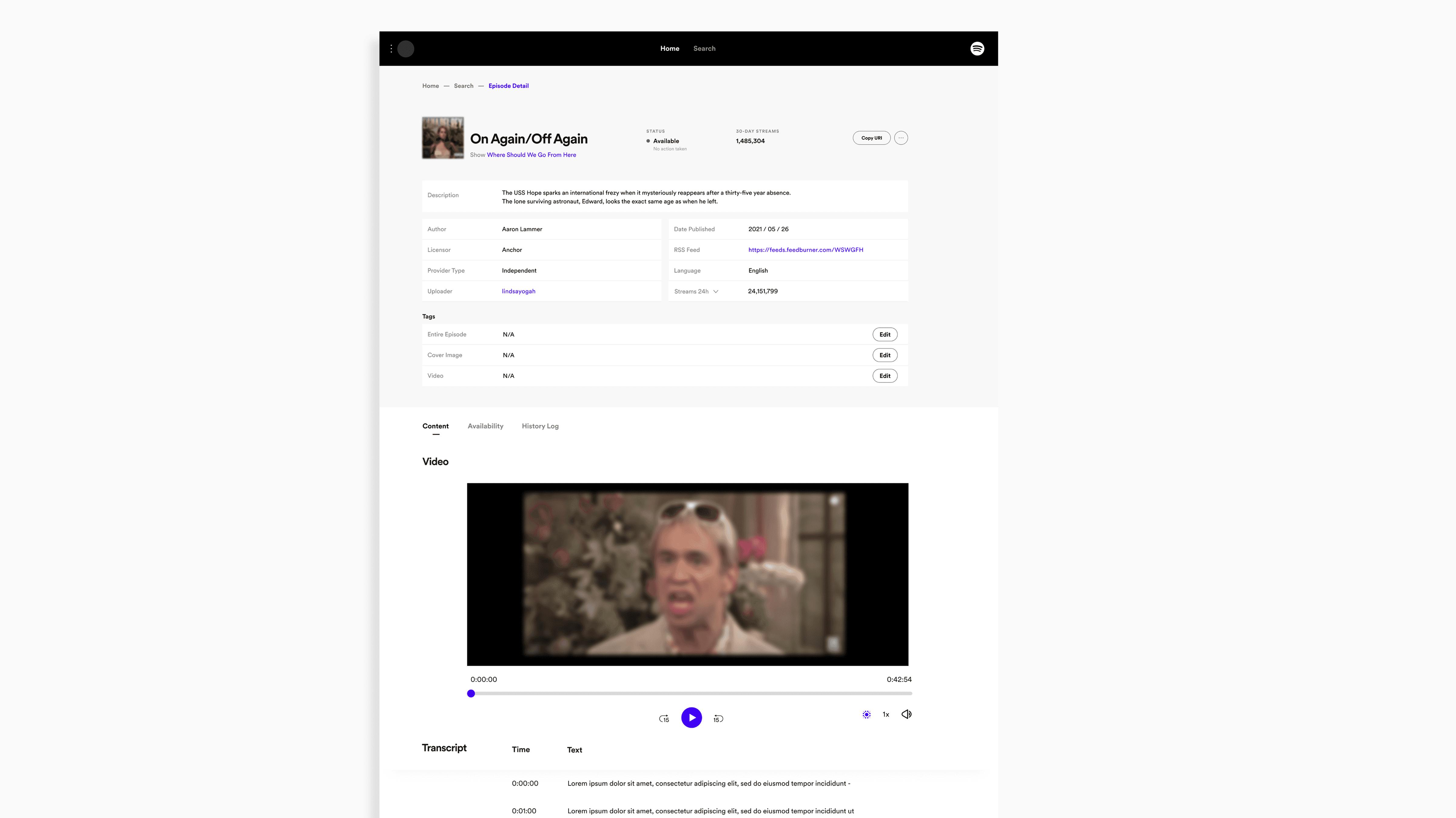
Making Monocle a single decision workspace
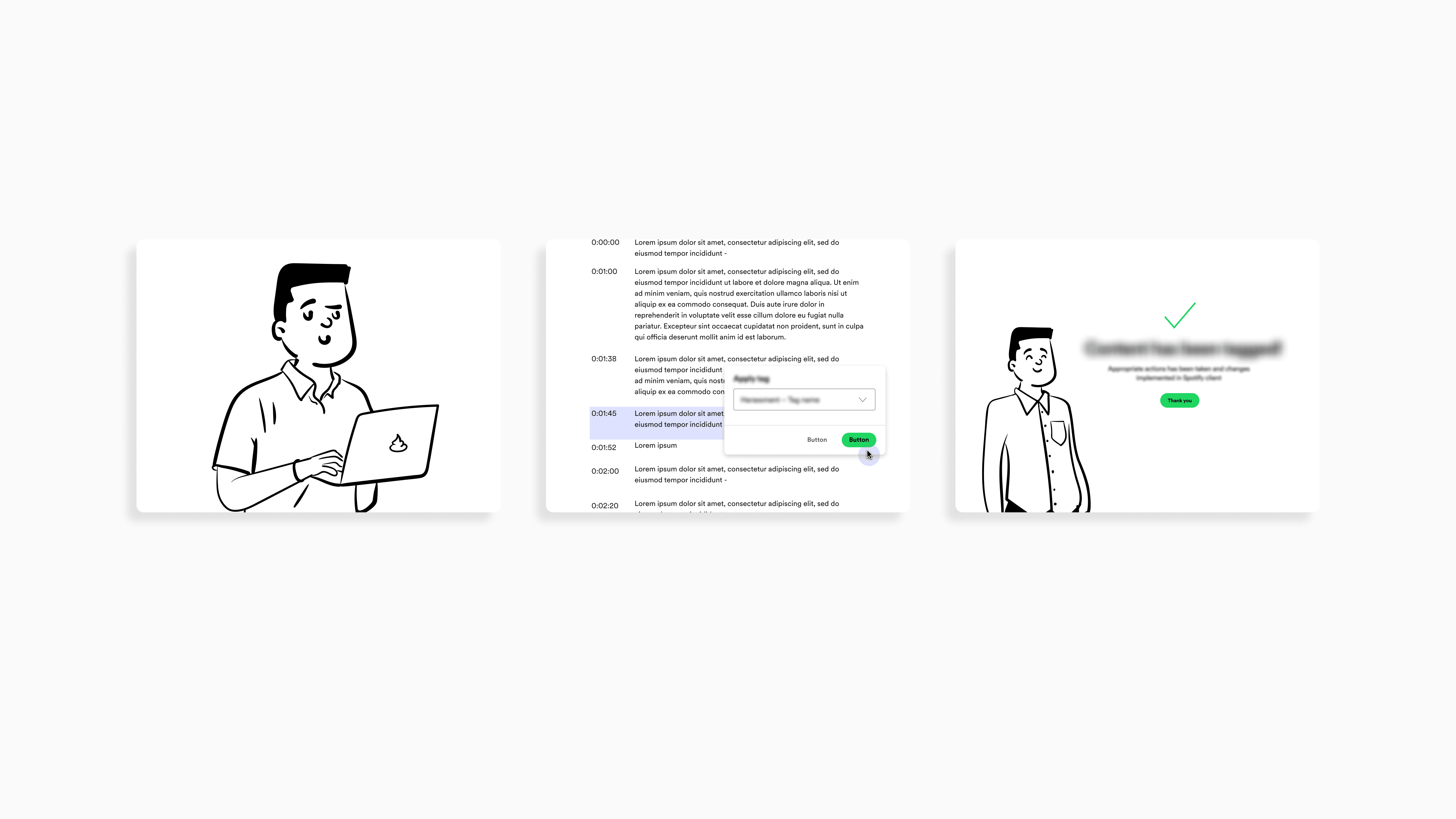
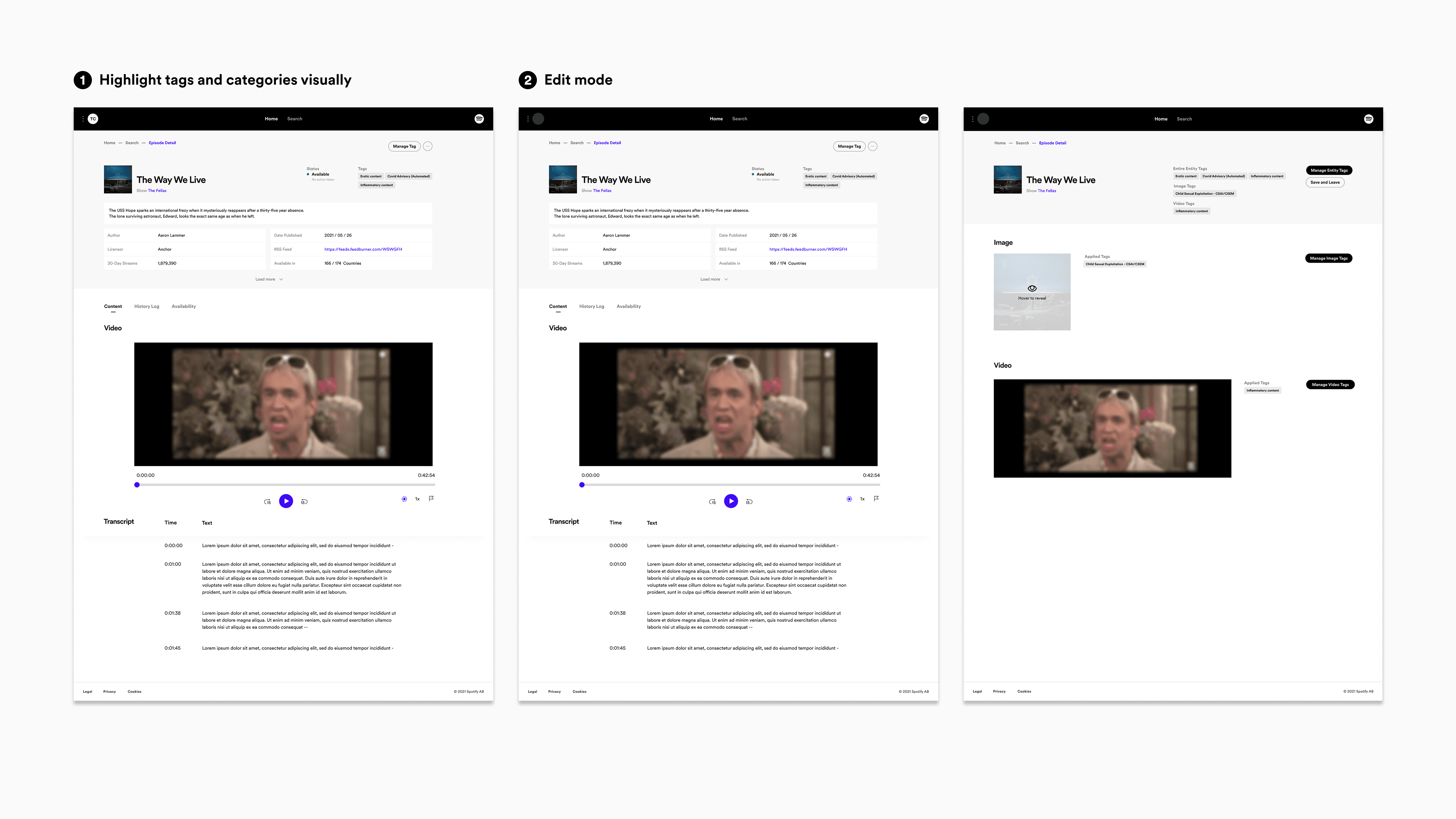
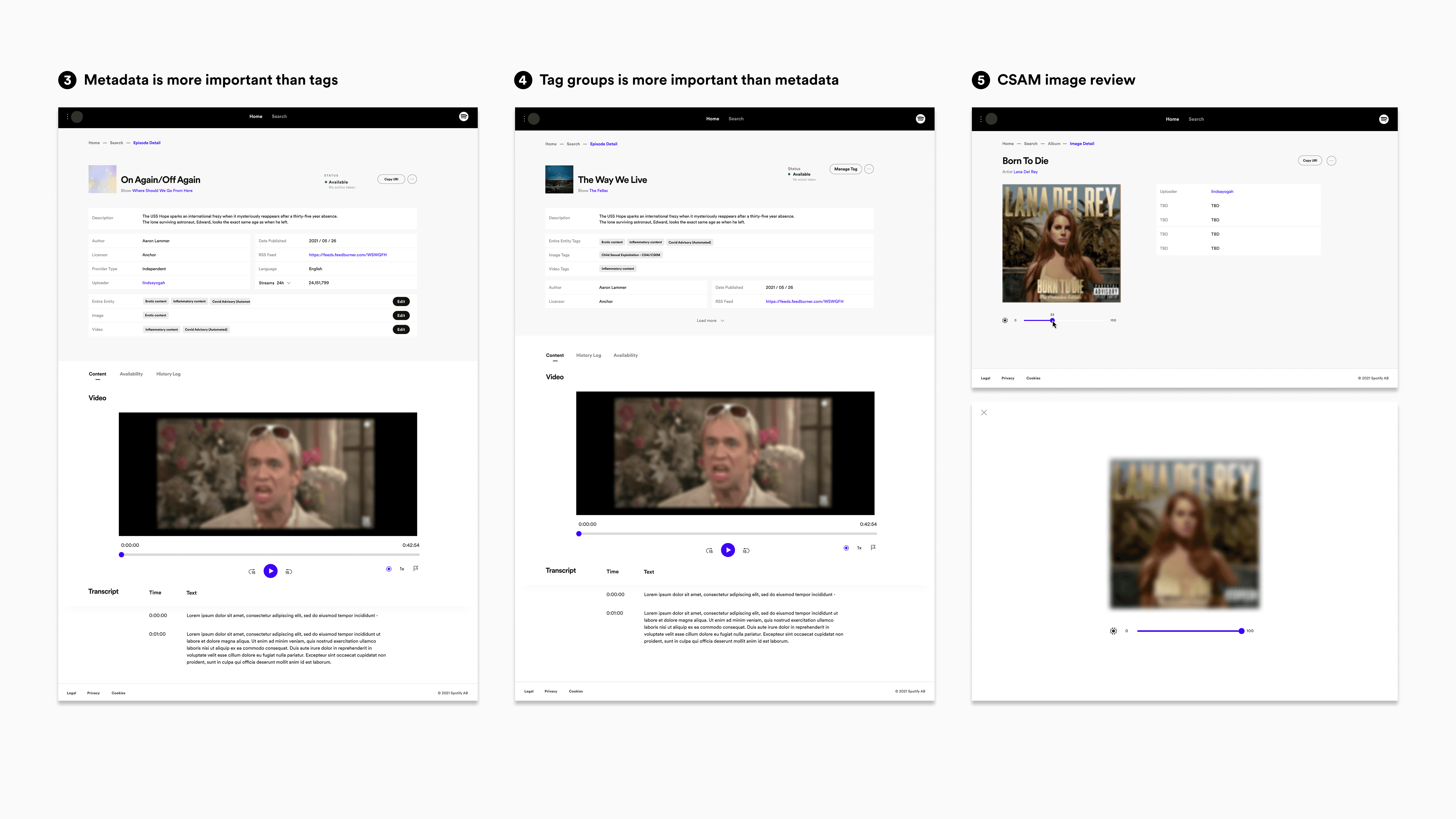
Monocle replaced fragmented moderation tooling with a single decision workspace, designed to reduce handling time without sacrificing accuracy or fairness.
I designed reusable review-and-action patterns so the same moderation decision model could be applied consistently across content types and regions.
Key decisions
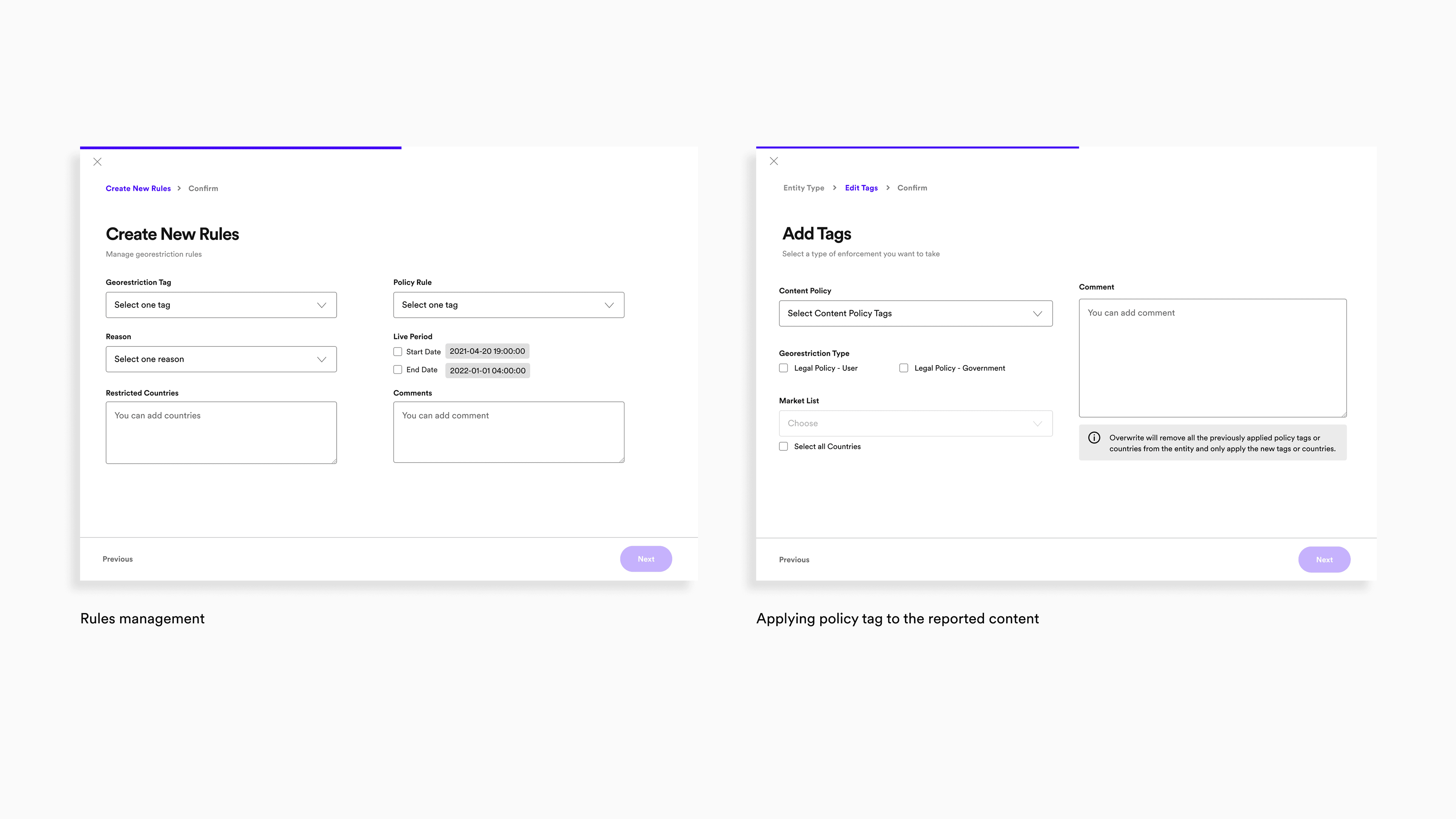
Defined a shared policy tag taxonomy with Policy teams
Consolidated content review and enforcement actions into one workflow
Designed explicit action paths (remove, restrict, label) following review
Created scalable moderation patterns supporting 7+ content types and global operator teams
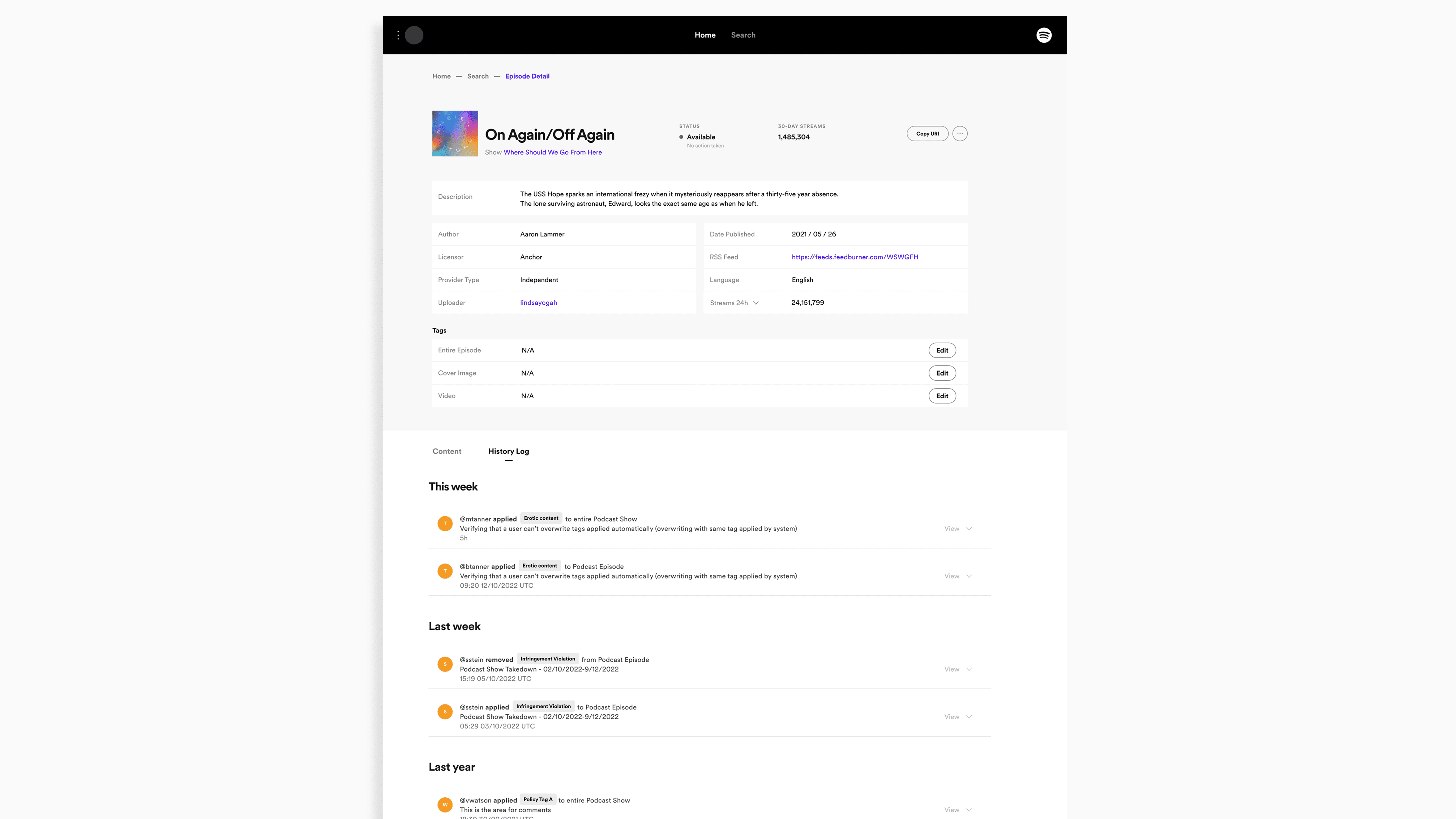
Embedded decision history and audit logs to support investigations and audits
These patterns were designed to scale without needing redesign for each new content type, which is what allowed Monocle to expand from music to 7+ content types across global operator teams without re-opening the core interaction model.
Design solutions
Making Monocle a single decision workspace
Monocle replaced fragmented moderation tooling with a single decision workspace, designed to reduce handling time without sacrificing accuracy or fairness.
I designed reusable review-and-action patterns so the same moderation decision model could be applied consistently across content types and regions.
Key decisions
Defined a shared policy tag taxonomy with Policy teams
Consolidated content review and enforcement actions into one workflow
Designed explicit action paths (remove, restrict, label) following review
Created scalable moderation patterns supporting 7+ content types and global operator teams
Embedded decision history and audit logs to support investigations and audits
These patterns were designed to scale without needing redesign for each new content type, which is what allowed Monocle to expand from music to 7+ content types across global operator teams without re-opening the core interaction model.
Outcome
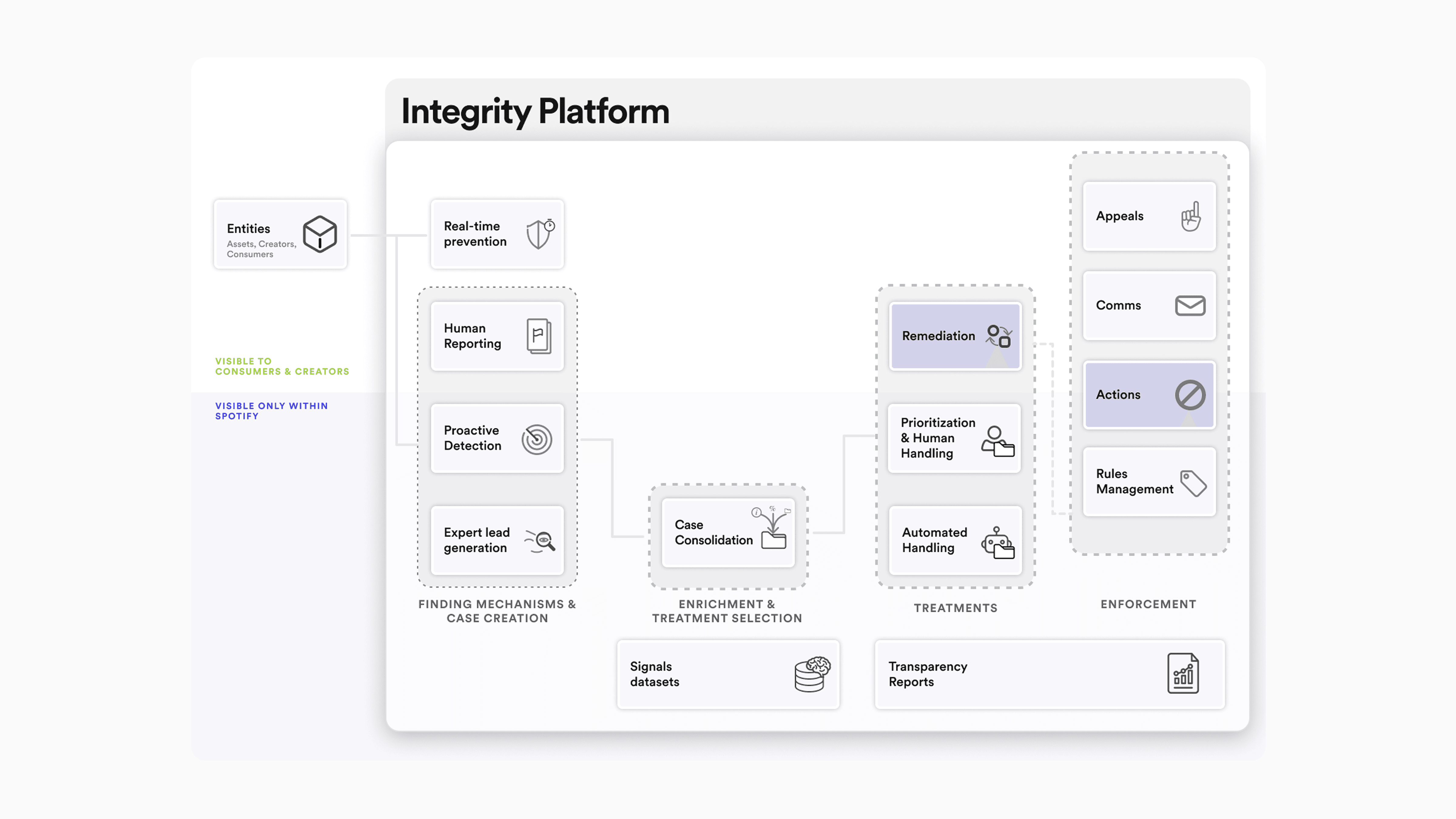
Together, Monocle and Appeals replaced fragmented moderation tools and email-based processes with a single, coherent enforcement system spanning internal operations and consumer-facing transparency.
Significant reduction in handling time across moderation and appeals
Tens of thousands of minutes saved daily, unlocking capacity across a large operator base
20+ legacy tools replaced, supporting 7+ content types with consistent enforcement logic
EU DSA compliance achieved ahead of enforcement, with auditable appeal flows and decision logs
As the system became coherent, operators focused more on judgment rather than navigation, while Policy and Legal teams gained a clear, traceable view of enforcement decisions.
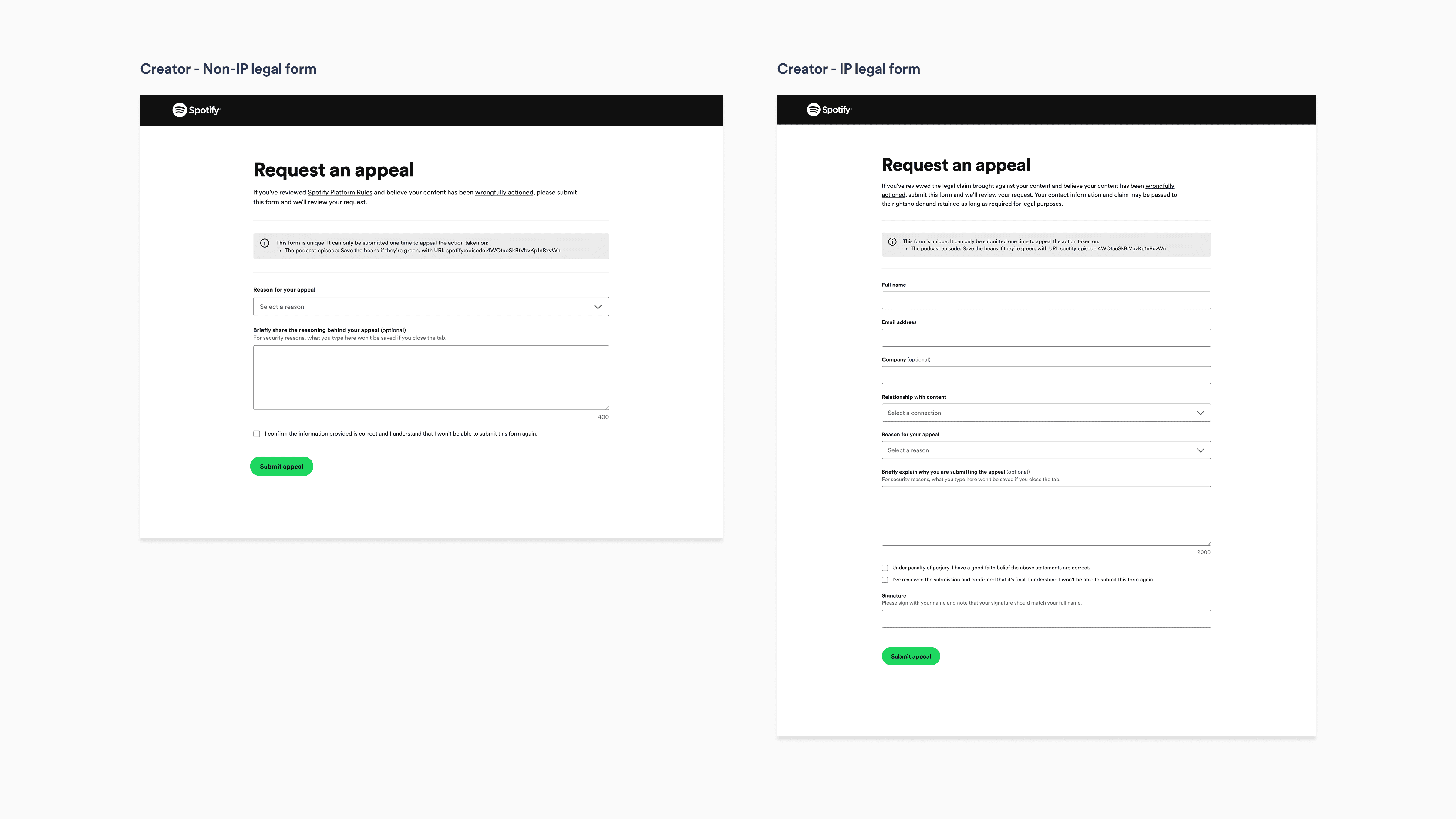
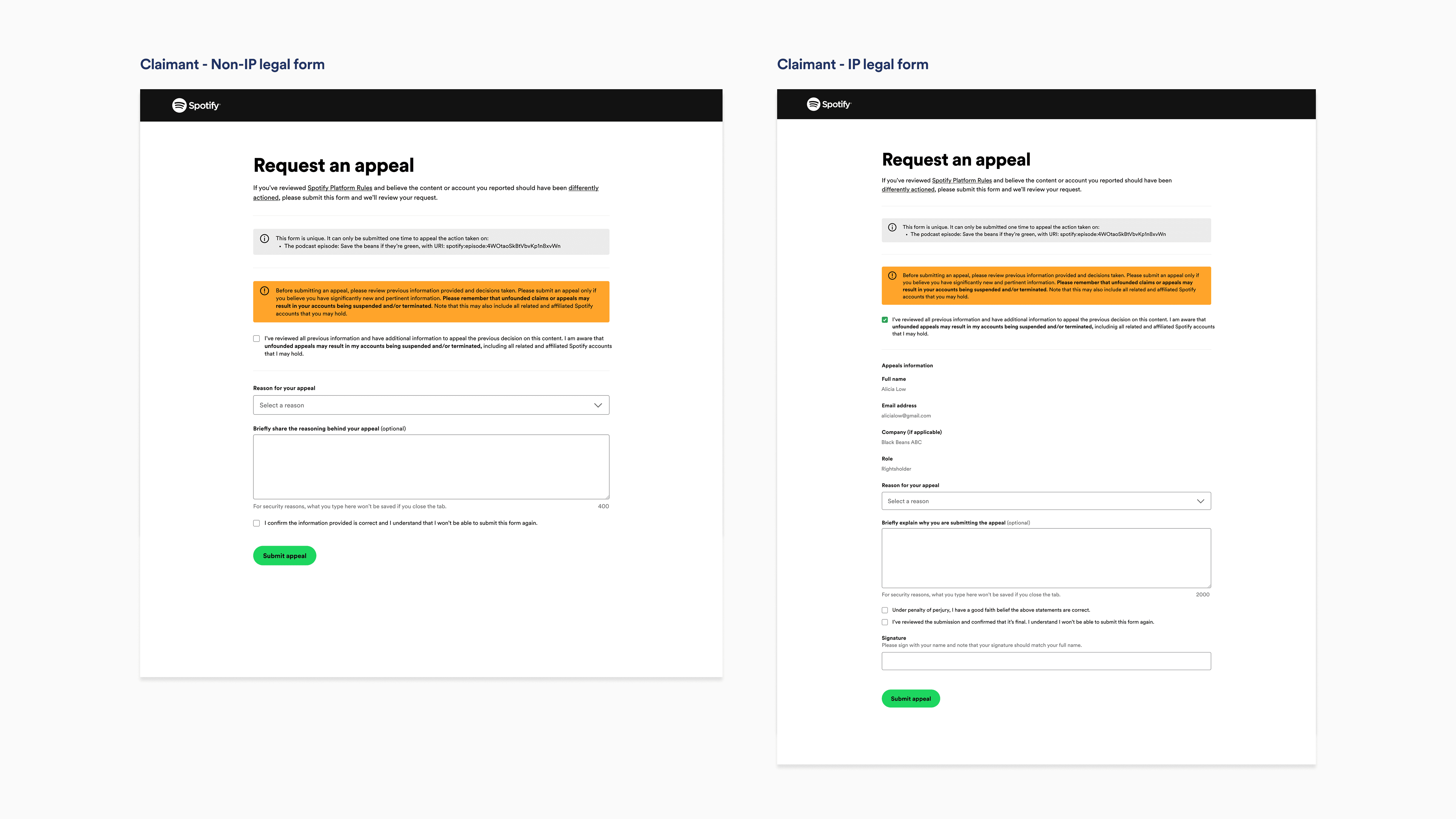
Designing Appeals as a 0→1 system under DSA
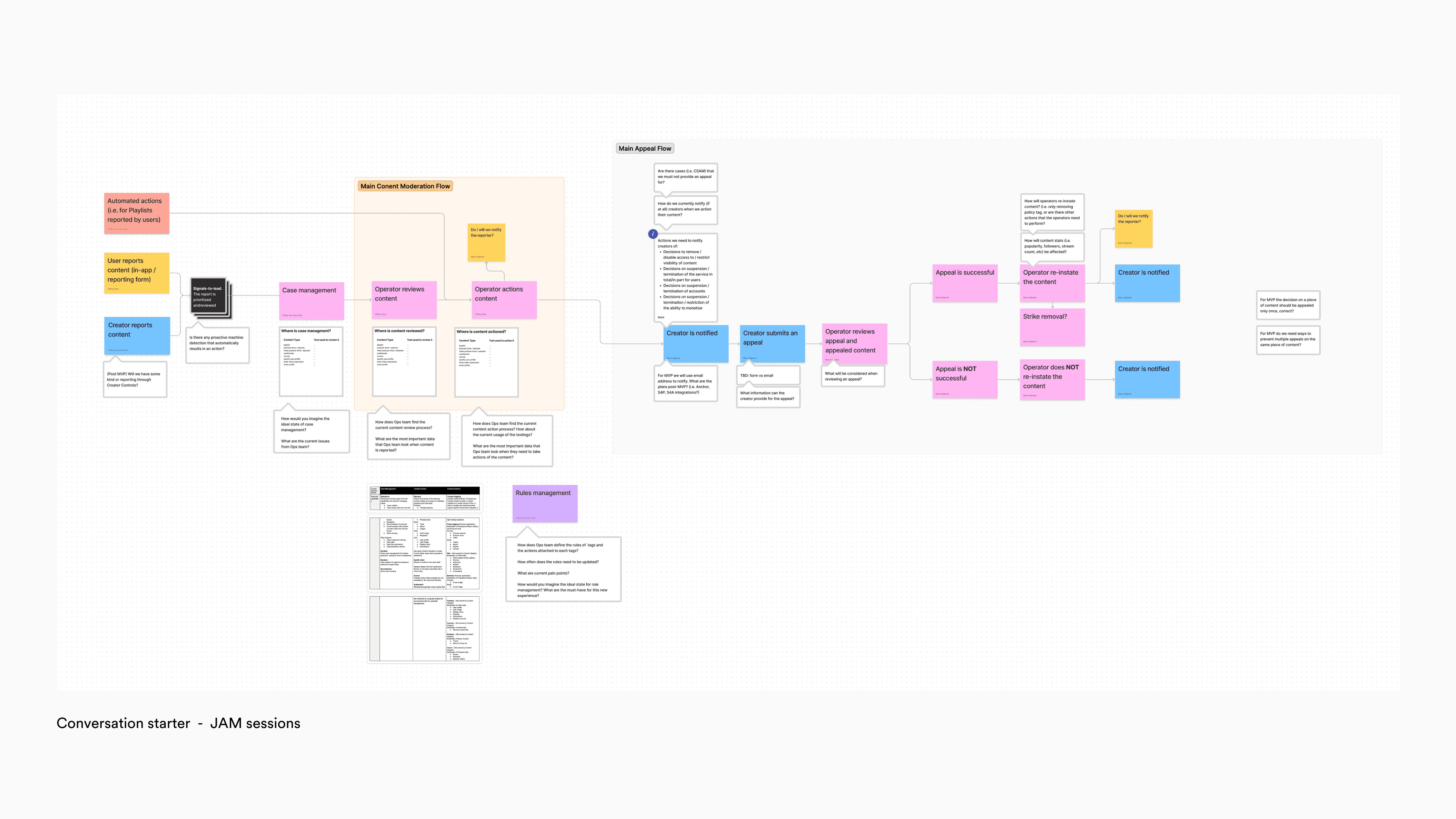
The DSA Appeals work started with no brief, no internal precedent, and a regulatory deadline. My first job was defining what the product problem actually was - translating legal obligations into something Design and Engineering could act on before enforcement began.
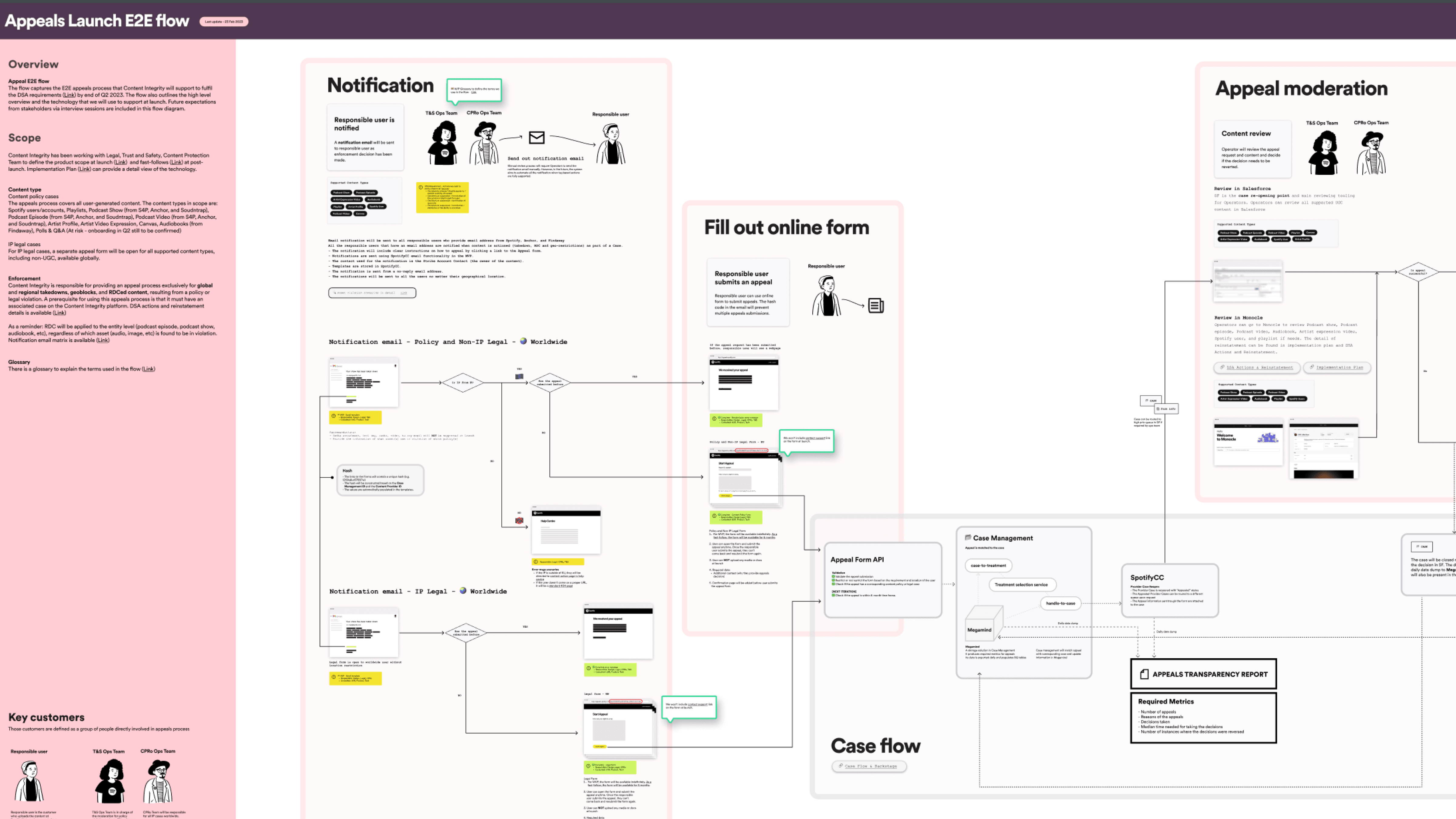
I designed the end-to-end appeal journey across creator notifications, appeal submission, claimant appeals, and internal moderator review. With 6 teams involved, spanning Legal, Policy, Engineering, and Product, and no shared picture of what the experience needed to be, I decided to create a service design diagram as the primary communication tool. It became the single source of truth that made the problem space concrete enough for all stakeholders to align on and build against.
Key decisions
Framed ambiguous legal requirements into clear product problems
Defined explicit appeal stages and user-visible status
Replaced email workflows with structured online appeal forms
Standardised appeal data for auditability, transparency reporting, and Salesforce case management
Design solutions
Monocle - a single decision workspace
Monocle replaced fragmented tooling with one clear review environment. The goal is to educe handling time without sacrificing accuracy or fairness.
Key decisions:
Consolidated context, history, and actions into one interface - Operators can review and apply tags to the content from one platform.
Defined a shared tagging structure with policy teams
Designed a clear information hierarchy to support fast, accurate decisions
Embedded decision history and audit logs directly into the workflow
Designing Appeals as a 0→1 system under DSA
The DSA Appeals work started with no brief, no internal precedent, and a regulatory deadline. My first job was defining what the product problem actually was - translating legal obligations into something Design and Engineering could act on before enforcement began.
I designed the end-to-end appeal journey across creator notifications, appeal submission, claimant appeals, and internal moderator review. With 6 teams involved, spanning Legal, Policy, Engineering, and Product, and no shared picture of what the experience needed to be, I decided to create a service design diagram as the primary communication tool. It became the single source of truth that made the problem space concrete enough for all stakeholders to align on and build against.
Key decisions
Framed ambiguous legal requirements into clear product problems
Defined explicit appeal stages and user-visible status
Replaced email workflows with structured online appeal forms
Standardised appeal data for auditability, transparency reporting, and Salesforce case management
Prioritisation
I worked with Product, Policy, Legal, and Engineering to prioritise based on operational bottlenecks, regulatory deadlines, and scale impact.
First, I partnered with the Global Trust & Safety Director to define a shared policy taxonomy, establishing the foundation for consistent tagging and enforcement.
Stakeholders wanted moderation tooling and rules management shipped together. With only 3–4 months to onboard Podcast Shorts, I pushed back, re-sequencing delivery to ship review and action first, and making the case that a half-built rules management feature would be harder to recover from than a phased roadmap. That call held.
Once Monocle v1 was adopted across 7+ content types, I led the design of the DSA Appeals service, aligning Trust & Safety, Content Protection, and Legal on compliant, auditable appeal journeys before enforcement.
This sequencing ensured operational stability while avoiding retrofitting compliance onto fragmented systems.
Outcome
Together, Monocle and Appeals replaced fragmented moderation tools and email-based processes with a single, coherent enforcement system spanning internal operations and consumer-facing transparency.
Significant reduction in handling time across moderation and appeals
Tens of thousands of minutes saved daily, unlocking capacity across a large operator base
20+ legacy tools replaced, supporting 7+ content types with consistent enforcement logic
EU DSA compliance achieved ahead of enforcement, with auditable appeal flows and decision logs
As the system became coherent, operators focused more on judgment rather than navigation, while Policy and Legal teams gained a clear, traceable view of enforcement decisions.
Outcome
Together, Monocle and Appeals replaced fragmented moderation tools and email-based processes with a single, coherent enforcement system spanning internal operations and consumer-facing transparency.
Significant reduction in handling time across moderation and appeals
Tens of thousands of minutes saved daily, unlocking capacity across a large operator base
20+ legacy tools replaced, supporting 7+ content types with consistent enforcement logic
EU DSA compliance achieved ahead of enforcement, with auditable appeal flows and decision logs
As the system became coherent, operators focused more on judgment rather than navigation, while Policy and Legal teams gained a clear, traceable view of enforcement decisions.
Designing Appeals as a 0→1 system under DSA
The DSA Appeals work started with no brief, no internal precedent, and a regulatory deadline. My first job was defining what the product problem actually was - translating legal obligations into something Design and Engineering could act on before enforcement began.
I designed the end-to-end appeal journey across creator notifications, appeal submission, claimant appeals, and internal moderator review. With 6 teams involved, spanning Legal, Policy, Engineering, and Product, and no shared picture of what the experience needed to be, I decided to create a service design diagram as the primary communication tool. It became the single source of truth that made the problem space concrete enough for all stakeholders to align on and build against.
Key decisions
Framed ambiguous legal requirements into clear product problems
Defined explicit appeal stages and user-visible status
Replaced email workflows with structured online appeal forms
Standardised appeal data for auditability, transparency reporting, and Salesforce case management
More projects
More projects

Scaling SumUp’s Hospitality Platform from MVP to Global Rollout
Scaling SumUp’s Hospitality Platform from MVP to Global Rollout
Cut merchant onboarding from weeks to days and supported 1M+ transactions across the UK, EU, US, and Brazil.
Cut merchant onboarding from weeks to days and supported 1M+ transactions across the UK, EU, US, and Brazil.
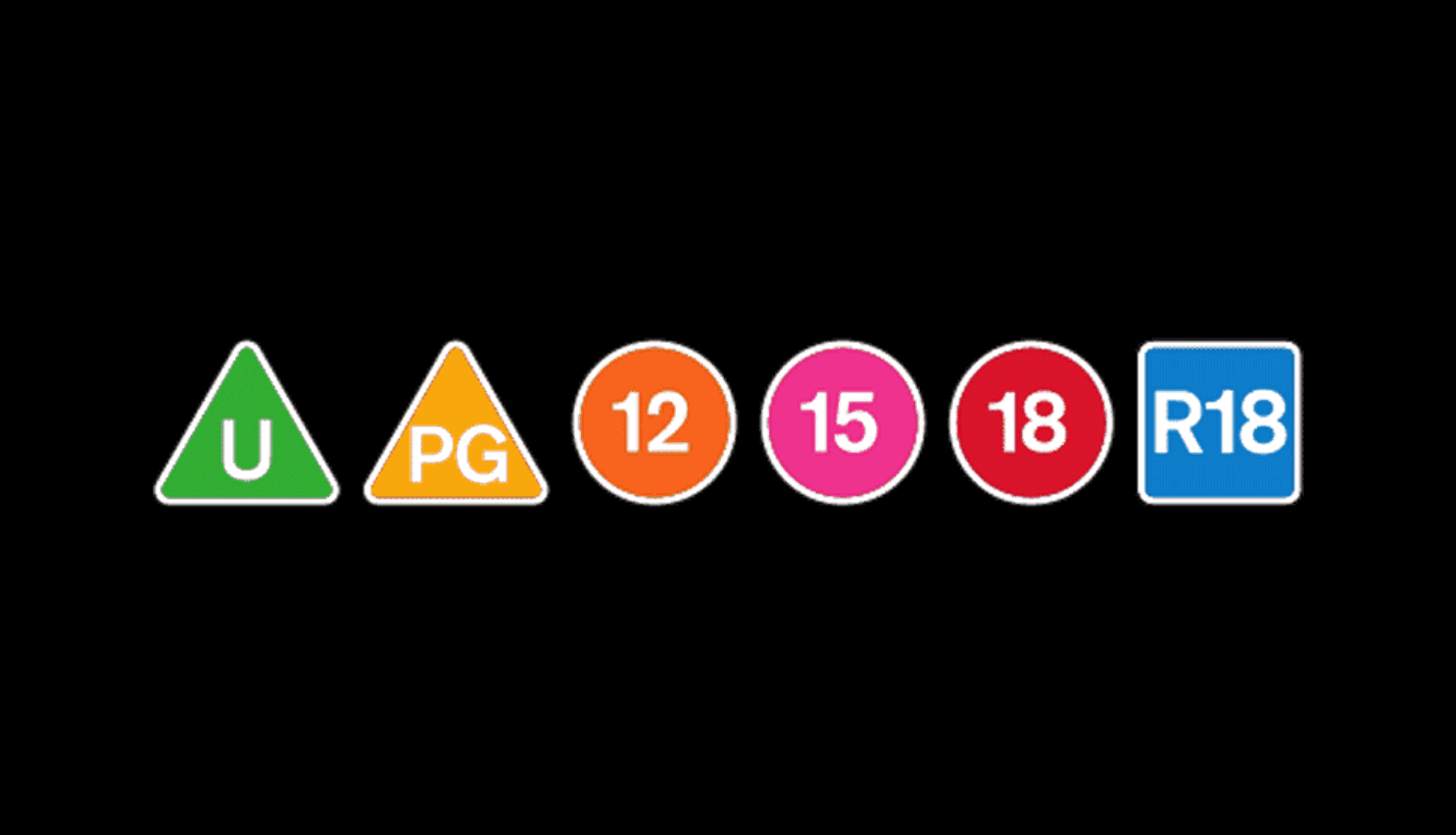
Reimagining BBFC’s Film Classification Platform
Reimagining BBFC’s Film Classification Platform
Cut report writing time by 50% and improved classification accuracy for 10K+ film reviews.